1 km Laboratory Validation — What We Actually Tested
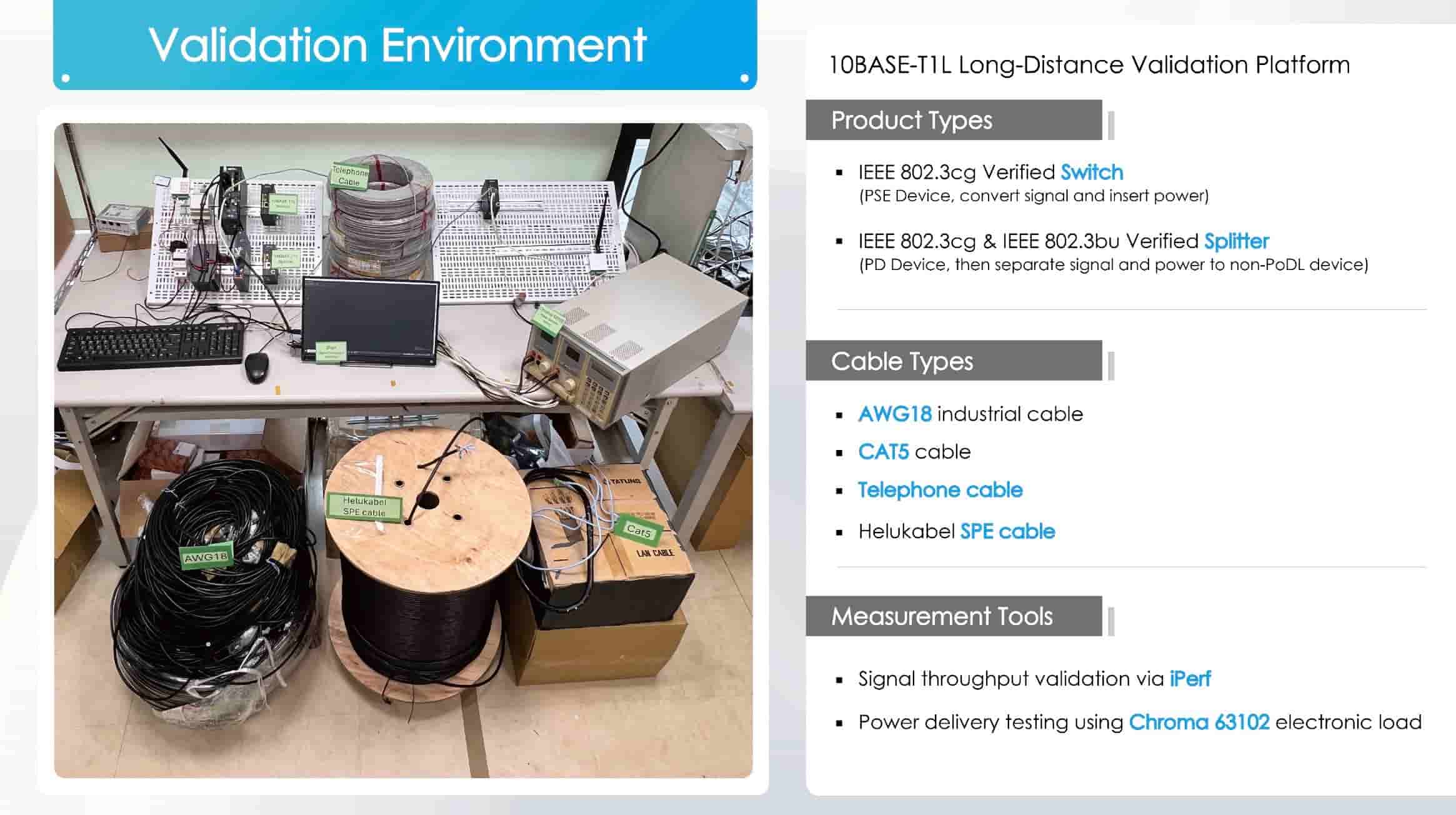
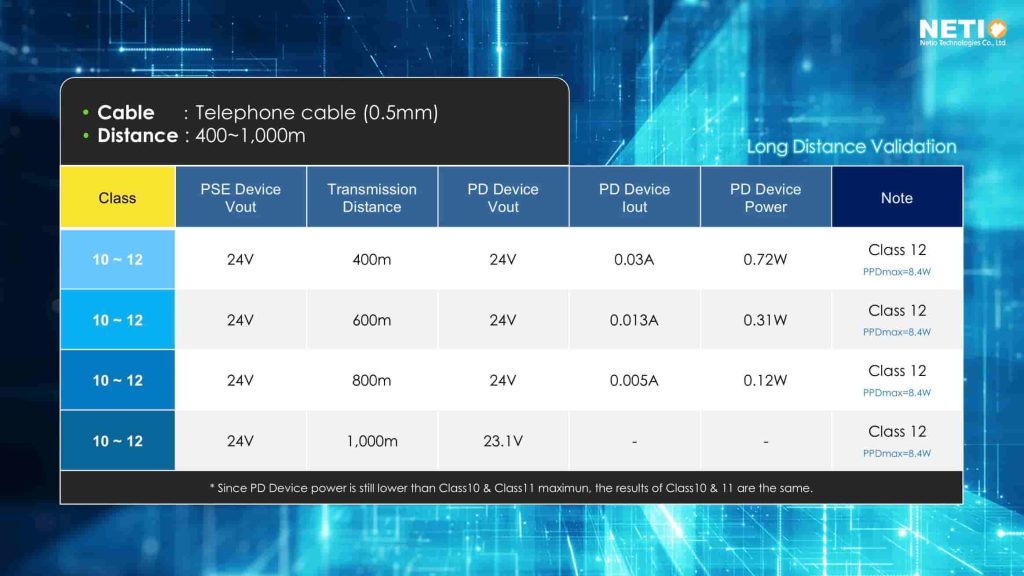
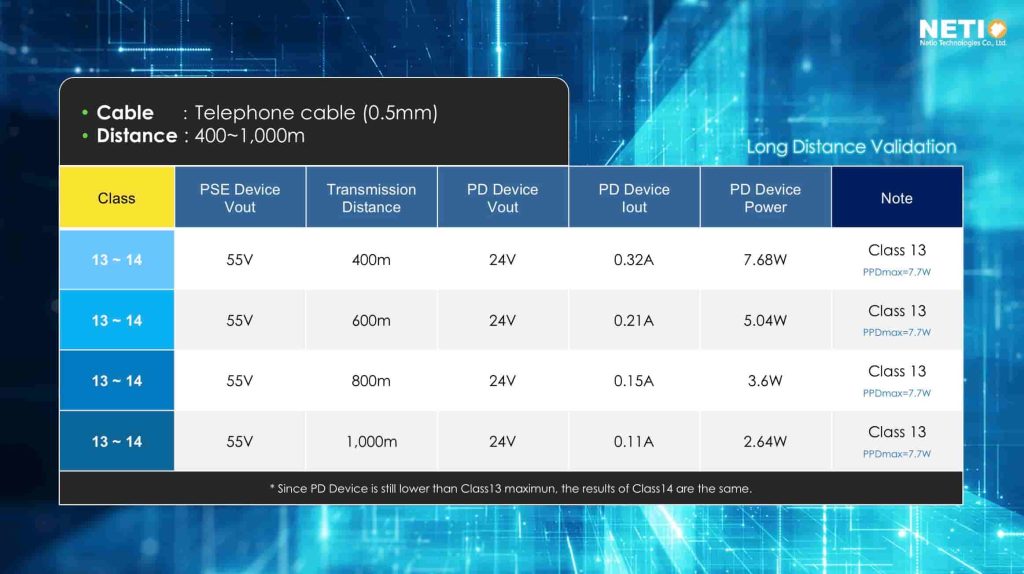
For many engineers, “1,000 meters” is often regarded as a theoretical specification. To verify the real-world performance of this capability across different cable types and PoDL classes, we conducted a series of systematic long-distance data transmission and power delivery validation tests.
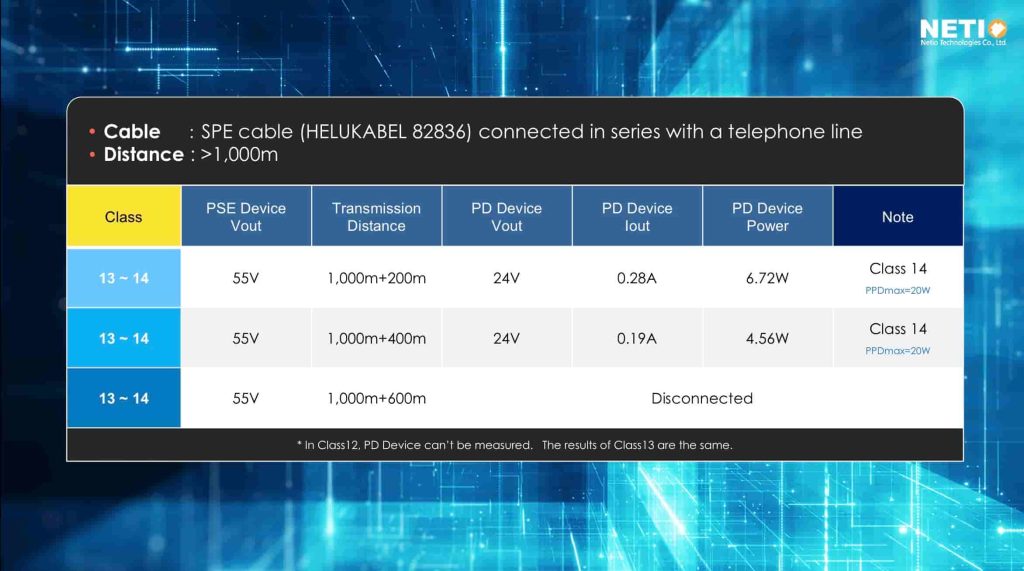
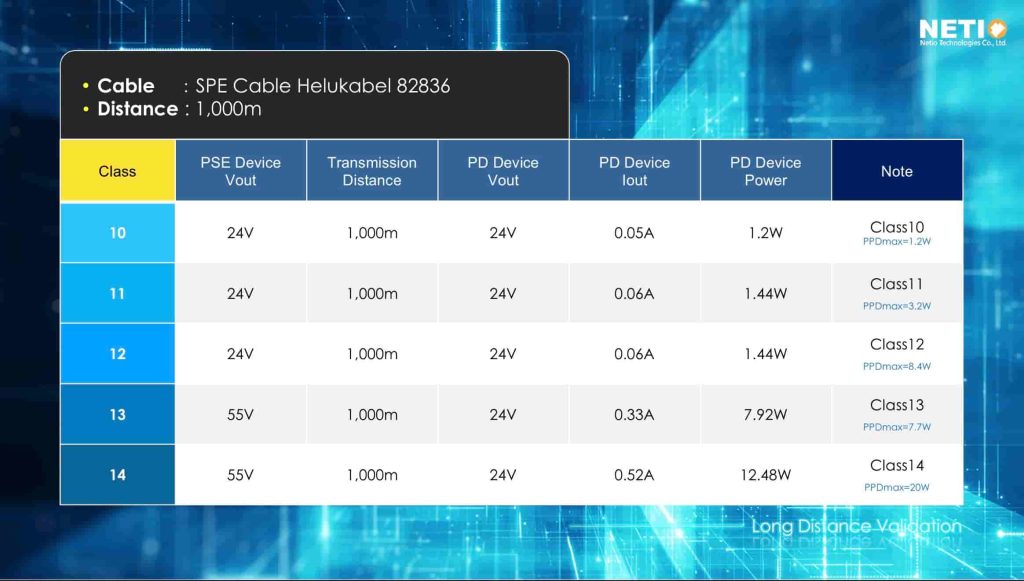
The tests were performed using dedicated SPE cabling (Helukabel 82836) deployed across the full 1,000-meter distance. The results showed that, from Class 10 through Class 14, the PD (Powered Device) side was able to reliably receive both data and power when the PSE (Power Sourcing Equipment) supplied the corresponding voltage levels—24V for Classes 10–12 and 55V for Classes 13–14. Power performance also remained within the expected range defined by each PoDL class specification.
For example, under Class 13 conditions, the PSE supplied 55V over a 1,000-meter link. Measurements at the PD side showed a current of 0.33A and power delivery of approximately 7.92W, remaining within the acceptable range of the Class 13 specification (PPDmax = 7.7W). Under Class 14 conditions at the same distance, the measured PD-side power reached 12.48W, also well within the specification limit (PPDmax = 20W).
These test results lead to a clear engineering conclusion: when appropriate SPE cabling is used, a 10BASE-T1L + PoDL system can reliably maintain both stable data communication and effective power delivery over distances of up to 1,000 meters. This capability is not merely a theoretical specification, but a practically validated deployment solution.
Under what conditions was the 1 km 10BASE-T1L test conducted?
Answer
The test used dedicated SPE twisted-pair cable conforming to IEC 61156-11 (characteristic impedance 100 Ω) in a controlled laboratory environment. Test items covered IEEE 802.3cg signal integrity metrics including Jitter measurement, Eye Diagram analysis, and PoDL power transmission efficiency across the full 1,000-meter distance.
Q2
How did Jitter perform in the test results, and what does this mean engineering-wise?
Answer
Test results showed Jitter at approximately 1.584 ns, achieving an 84% margin relative to the IEEE 802.3cg specification limit. A higher Jitter margin means better signal timing stability, allowing the deployed system to tolerate environmental noise and cable aging-induced signal degradation over time — indicating strong long-term reliability.
Q3
What is the difference between dedicated SPE cable and general twisted-pair wire for 1 km transmission?
Answer
Dedicated SPE cable is impedance-optimized for 10BASE-T1L signal characteristics, providing ample signal margin at 1 km. General-purpose twisted-pair wire (such as telephone wire) has less consistent impedance, leading to greater signal attenuation over long distances. Additional validation testing is required to confirm usability before deployment.
Netio Technologies
Your Best Design Partner !
We use cookies on our website to give you the most relevant experience by remembering your preferences and repeat visits. By clicking “Accept All”, you consent to the use of ALL the cookies. However, you may visit "Cookie Settings" to provide a controlled consent.
This website uses cookies to improve your experience while you navigate through the website. Out of these, the cookies that are categorized as necessary are stored on your browser as they are essential for the working of basic functionalities of the website. We also use third-party cookies that help us analyze and understand how you use this website. These cookies will be stored in your browser only with your consent. You also have the option to opt-out of these cookies. But opting out of some of these cookies may affect your browsing experience.
More product information
Thank you for reaching out. We will get back to you as soon as possible.