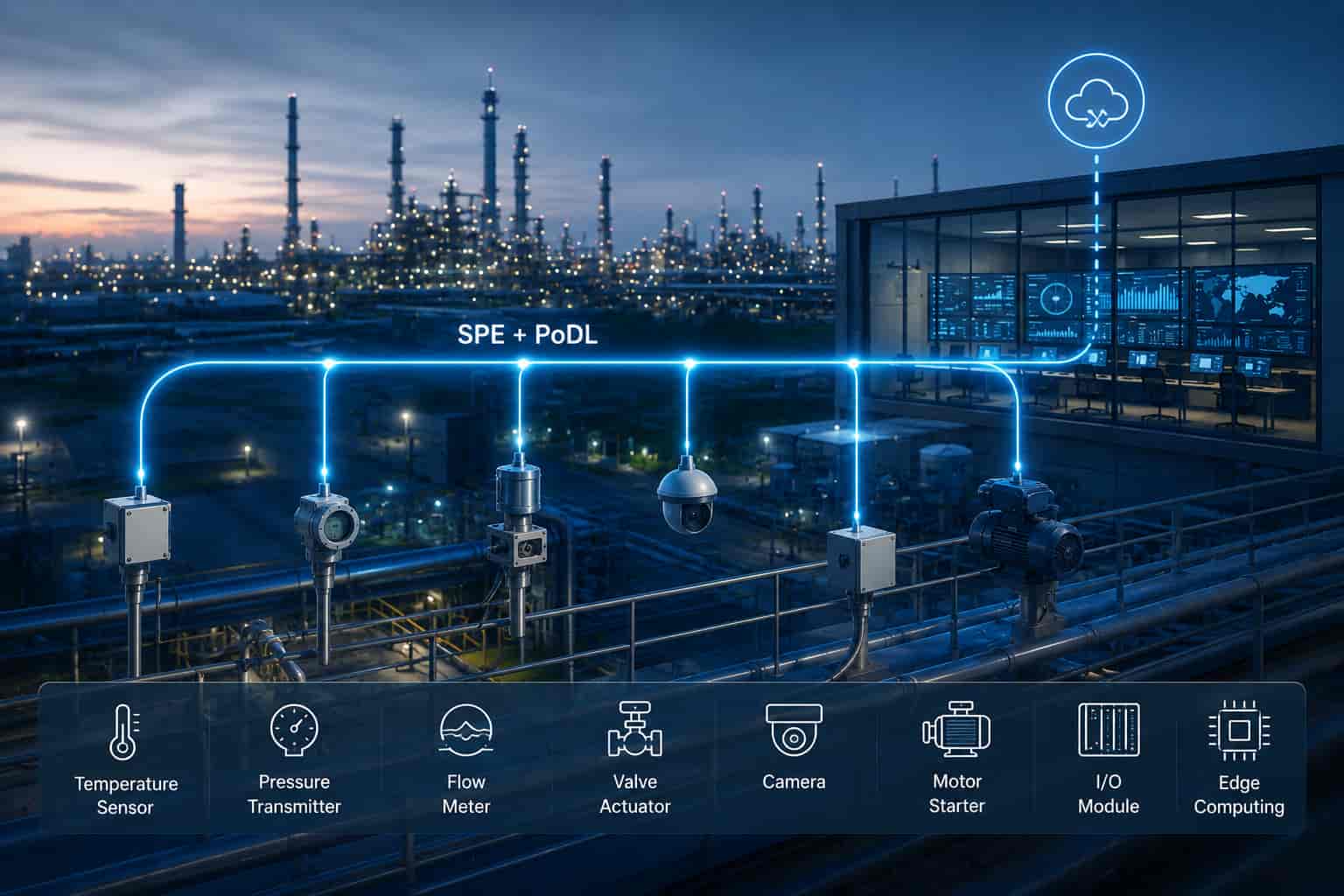
The PoDL standard defines six power classes from Class 10 to Class 15, to meet the power needs of field devices with different requirements. Understanding the power delivery capability of each class is a key reference for system design selection.
PoDL Class
System Voltage
Max PD Available Power
Typical Applications
Class 10
24 VDC
~1.2 W
Simple sensors (temperature, humidity)
Class 11
24 VDC
~3.4 W
Sensors, energy meters
Class 12
24 VDC
~8.4 W
Advanced sensors
Class 13
50–58 VDC
~7.7 W
Cameras, HMI panels
Class 14
50–58 VDC
~20 W
Actuators
Class 15
50–58 VDC
Up to ~52 W
High-power equipment
Classes 10–12 use a 24 VDC system voltage, suitable for low-power sensors; Classes 13–15 step up to 50–58 VDC to support cameras or industrial actuators requiring higher power. Special mention must be made of the Intrinsic Safety scenario. In the Ethernet-APL specification, for Zone 0 (highly explosive area) equipment, power is strictly limited to approximately 500–540 mW to ensure safety. The above Class classification does not apply in this context and must be designed according to APL safety specifications.
This complete Class system allows PoDL to flexibly cover power needs from the simplest temperature sensors to edge computing modules requiring substantial power — virtually all industrial field devices can find a corresponding solution.
FAQ
Q1
What are the differences in PoDL Classes 10 through 15, and which devices are they suited for?
Answer
PoDL defines six classes: Classes 10–12 use 24 VDC with maximum PD power of approximately 1.2 W, 3.4 W, and 8.4 W respectively, suitable for low-power sensors such as temperature and humidity sensors; Classes 13–15 use 50–58 VDC with approximately 7.7 W, 20 W, and up to 52 W, suited for cameras, HMI panels, actuators, and other higher-power devices.
Q2
What are the PoDL power restrictions in hazardous areas (Ethernet-APL)?
Answer
Under the Ethernet-APL specification for Zone 0 highly explosive areas, line power is strictly limited to approximately 500–540 mW to ensure Intrinsic Safety. The standard Class 10–15 classification does not apply in this context — a separate design based on Intrinsic Safety specifications is required.
Q3
How should engineers select the appropriate PoDL Class for a system design?
Answer
Key selection criteria are the end device’s power consumption requirements and system voltage compatibility. Low-power sensors call for Classes 10–12 (24 V system); cameras or actuators with higher power needs require Classes 13–15 (50–58 V system). Cable length’s effect on actual available power must also be considered — the longer the distance, the greater the line resistance losses.
Netio Technologies
Your Best Design Partner !
We use cookies on our website to give you the most relevant experience by remembering your preferences and repeat visits. By clicking “Accept All”, you consent to the use of ALL the cookies. However, you may visit "Cookie Settings" to provide a controlled consent.
This website uses cookies to improve your experience while you navigate through the website. Out of these, the cookies that are categorized as necessary are stored on your browser as they are essential for the working of basic functionalities of the website. We also use third-party cookies that help us analyze and understand how you use this website. These cookies will be stored in your browser only with your consent. You also have the option to opt-out of these cookies. But opting out of some of these cookies may affect your browsing experience.
More product information
Thank you for reaching out. We will get back to you as soon as possible.