

Solutions > Industrial Ethernet > 10BASE-T1L vs. Traditional Fieldbuses — From 4–20 mA to SPE
10BASE-T1L vs. Traditional Fieldbuses — From 4–20 mA to SPE
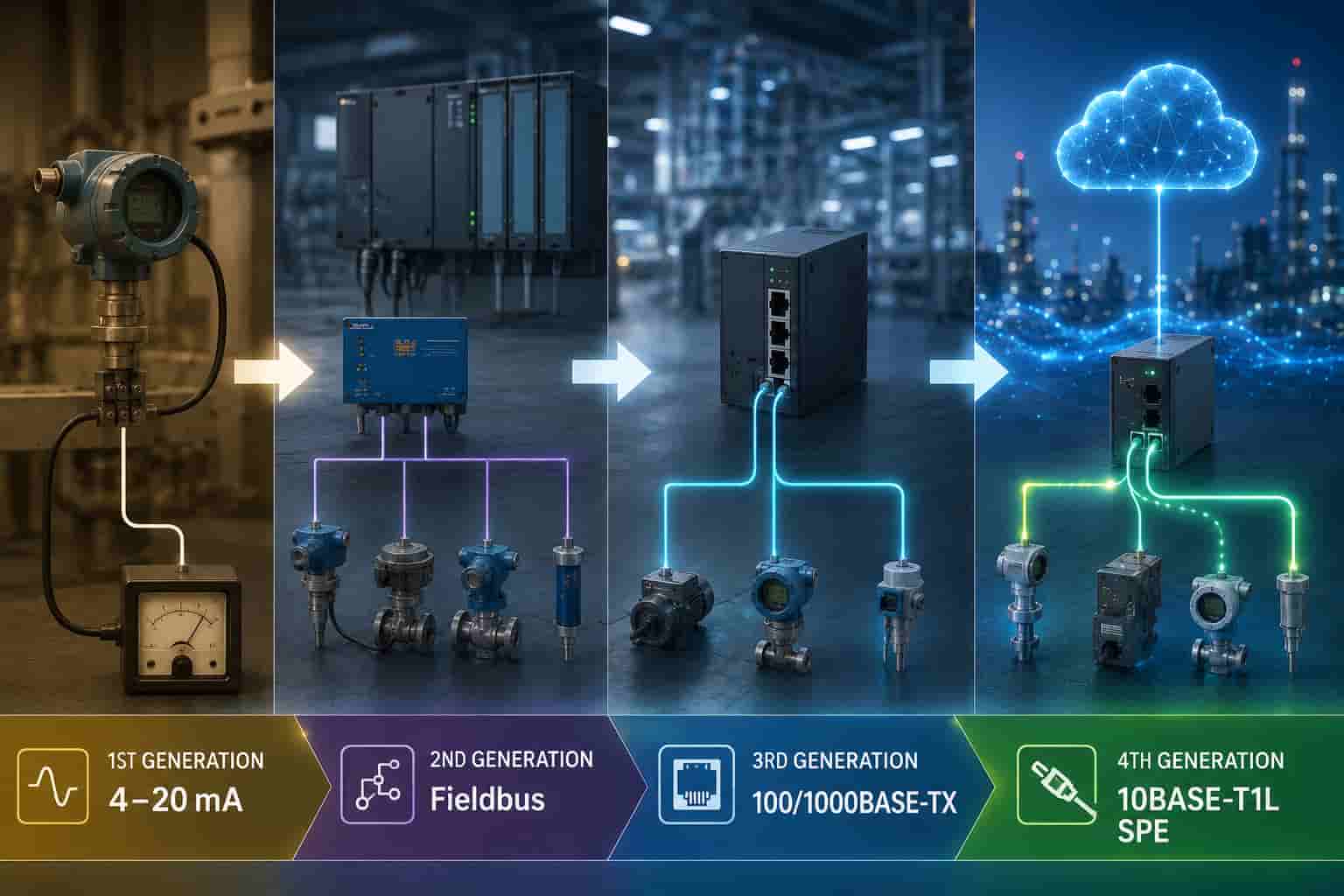
To understand the value of 10BASE-T1L, the best approach is to review the evolution of industrial communication technology.
Generation 1: 4–20 mA Analog Signals
For decades, 4–20 mA current loops were the mainstream connection method for industrial sensors. Simple and reliable, but each loop can only carry one process variable at bandwidths of just a few hundred bps, unable to support real-time transmission of device diagnostic information. The HART protocol overlaid digital signals on 4–20 mA, but practical usable bandwidth remained extremely limited.
Generation 2: Fieldbus
PROFIBUS, Foundation Fieldbus, DeviceNet and other fieldbuses greatly improved digitalization, allowing multiple nodes to share the same bus and supporting remote configuration of device parameters. However, different Fieldbus standards are mutually incompatible, and their speed and integration capabilities remain far below Ethernet, creating ‘data silo’ problems.
Generation 3: Standard Ethernet (100/1000BASE-TX)
Factory upper layers (SCADA, MES) have long fully adopted standard Ethernet, but the 100-meter maximum transmission distance prevents direct extension to remote field devices. Multiple layers of gateways and protocol conversions are needed to bridge the gap, adding cost and complexity.
Generation 4: 10BASE-T1L SPE
10BASE-T1L fills the final gap — extending IP Ethernet all the way to field sensors 1 kilometer away without increasing cabling costs. It eliminates the need for protocol conversion; data can flow directly from the sensor end to the cloud with no more data silos. Combined with PoDL power delivery capability, it can even replace separate power lines, achieving a true ‘one wire does it all’ deployment model.
For industrial engineers, this represents not just a cable upgrade, but a paradigm shift in the entire OT network architecture.
FAQ
Q1
What is the maximum transmission distance of 10BASE-T1L, and how does it compare to traditional Ethernet?
Answer
10BASE-T1L reaches up to 1,000 meters, while traditional standard Ethernet (100BASE-TX / 1000BASE-T) is limited to just 100 meters. This allows 10BASE-T1L to cover most field device-to-control-room distances in large factories or buildings without any repeater equipment.
Q2
Which existing protocols is 10BASE-T1L compatible with? Are additional gateways required?
Answer
10BASE-T1L only defines the physical layer. Upper-layer protocols are fully compatible with standard Ethernet, including TCP/IP, PROFINET, EtherNet/IP, OPC UA, and Modbus-TCP. Existing software stacks and IT tools can be used directly — no additional protocol gateways are required.
Q3
What are the two signal voltage modes of 10BASE-T1L, and when is each used?
Answer
10BASE-T1L supports 1.0 V p-p and 2.4 V p-p signal voltage modes. The 1.0 V p-p mode is used in hazardous areas requiring Intrinsic Safety; the 2.4 V p-p mode is used in non-hazardous environments, tolerating higher cable attenuation to achieve longer transmission distances.

Netio Technologies
Your Best Design Partner !