
You're Paying for Energy You Can't Account For. That Needs to Change.
Wireless Equipment-Level Power Monitoring Is Giving Facility Managers Visibility They've Never Had Before
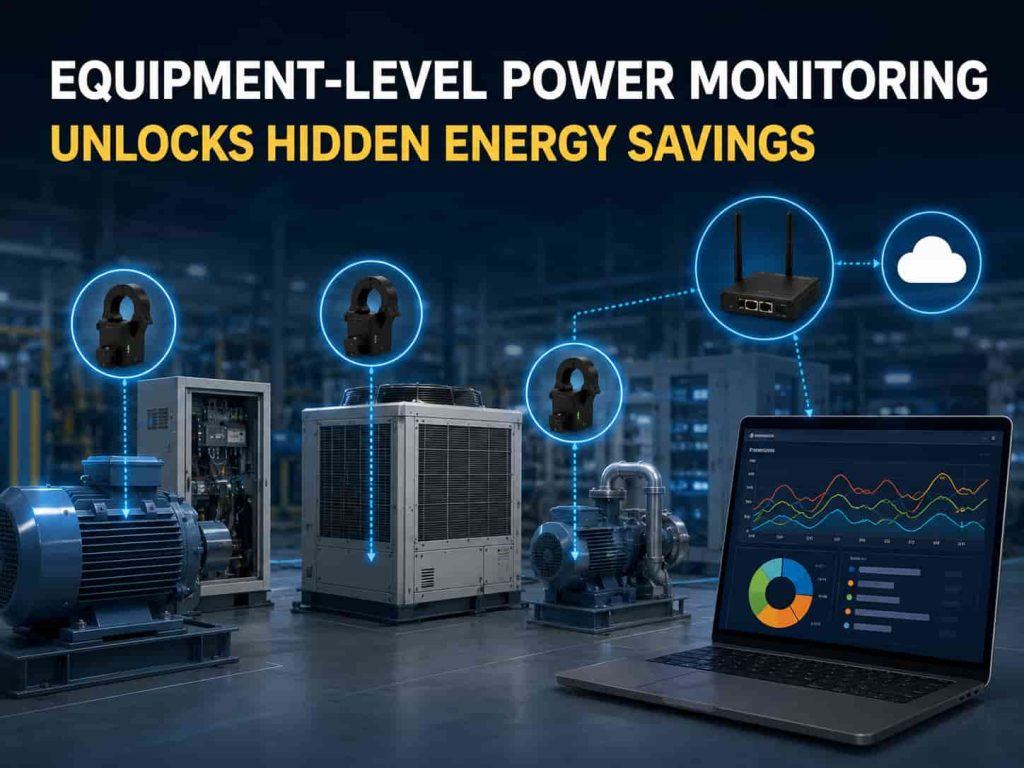
The monthly electricity bill lands on your desk. The number is significant — and completely opaque. You know how much energy the building consumed. You have no idea where it actually went.
Which HVAC unit ran through the night when nobody was in the building? Which server rack has been drawing 15% more power than it should? Which production line sits idle but fully energized for two hours every shift?
Traditional submetering can’t answer those questions. It stops at the circuit level, and retrofitting wired monitors to individual machines means shutting down equipment and running conduit — expensive, disruptive, and rarely worth the effort for more than a handful of high-priority assets.
The result: most facilities are flying blind on energy consumption at the device level.
The Five Problems Wireless Monitoring Solves
The energy management challenges that come up most often aren’t mysteries. They’re predictable — and they all stem from the same root cause: a lack of granular, real-time visibility.
● You see the total bill, not the breakdown — no insight into which equipment is driving costs
● Too many assets, too little structure — impossible to identify your biggest energy consumers without individual data
● Anomalies go undetected for weeks — waste accumulates silently before anyone notices
● Traditional monitoring requires downtime and rewiring — the cost of deployment has always outweighed the benefit for most assets
● ESG and carbon reporting demands are rising — auditors and stakeholders need traceable, time-stamped consumption data
Wireless IoT now makes it practical to address all five — at scale, without disruption.
How It Works: Three Components, Complete Visibility
Wireless Current Sensor: Clips directly onto existing wiring—no cutting, no shutdown, no electrician required. Monitors real-time current draw and AC frequency, giving you a continuous picture of each asset’s energy behavior and utilization patterns.
Wireless Smart Meter: Metering-grade precision, with active power measurement accuracy within ±0.5%. Captures the full picture: voltage, current, power factor, and active power. Logs cumulative consumption with timestamped interval records — exactly what compliance teams and ESG auditors need.
LoRa Edge Gateway: Connects via Ethernet, Wi-Fi, or LoRa — whichever fits your environment. Handles data preprocessing at the edge, so sensitive operational data stays on-site. Scales seamlessly as your monitoring footprint grows.
Put these three together and you get device-level energy visibility across your entire facility — installed without touching a single existing circuit.
Where AI Turns Data Into Decisions
For a large industrial facility or data center, annual energy spend can run well into the millions. A 3% improvement sounds modest — until you work out what it actually means in dollar terms. The AI layer on top of the monitoring platform is what makes that kind of optimization achievable: automated anomaly alerts, HVAC correlation analysis, after-hours utilization tracking, and one-click ESG reporting ready for carbon tracking and compliance submissions. Knowing where your energy goes is the first step to controlling it. The good news: getting there is simpler than most facilities expect.
FAQ
Q1
Can you install power monitoring equipment without shutting down factory operations?
Answer
Yes, and in most cases, that’s exactly how it’s done. Clip-on wireless current sensors attach directly to existing cables without cutting wires or interrupting power. Installation typically takes a few hours and, combined with a LoRa wireless gateway, requires no new cabling at all. The whole process runs in parallel with normal operations, with zero downtime.
Q2
What’s the difference between device-level power monitoring and a standard electricity meter?
Answer
A standard meter tells you how much electricity the building consumed. Device-level monitoring tells you which machine consumed it, when, and whether that consumption was normal. That granularity is what turns an energy bill into an actionable dataset — you can identify your biggest consumers, catch equipment drawing more power than it should, and find real opportunities for reduction.
Q3
How does device-level power monitoring support ESG reporting?
Answer
Device-level monitoring generates timestamped, device-specific energy consumption data that can be automatically converted to CO₂ equivalent figures using regional grid emission factors. The output meets GHG Protocol formatting requirements and carries the sensor-level traceability that third-party auditors need. It’s the most reliable foundation for corporate carbon reporting — far more credible than manual reads or monthly estimates.

Netio Technologies
Your Best Design Partner !