
The Air in Your Factory Is Hurting Your People — And Most Facilities Have No Idea
Environmental monitoring is one of those things that doesn’t get attention until something goes wrong. A rash of workplace health complaints. A failed compliance audit. A productivity dip that takes months to trace back to air quality. By then, the damage is already done.
In most manufacturing facilities, nobody actually knows what the air quality looks like on the production floor. CO₂ levels accumulate silently as headcount and machine activity increase. PM2.5 particles generated by welding, coating, or machining operations stay suspended long after the work is done. Temperature and humidity drift into ranges that compromise both worker comfort and product consistency — and nobody flags it because nobody’s watching.
What the Numbers Look Like When You Start Measuring
CO₂ concentration above 1,000 ppm has measurable effects on cognitive function and error rates. In enclosed production areas with high occupancy and active machinery, hitting that threshold during peak hours is surprisingly easy. PM2.5 exposure from manufacturing processes is a long-term respiratory health risk — one that regulatory frameworks increasingly require facilities to monitor and document.
Wireless Sensor Networks: Practical to Deploy, Hard to Ignore Once You Have the Data
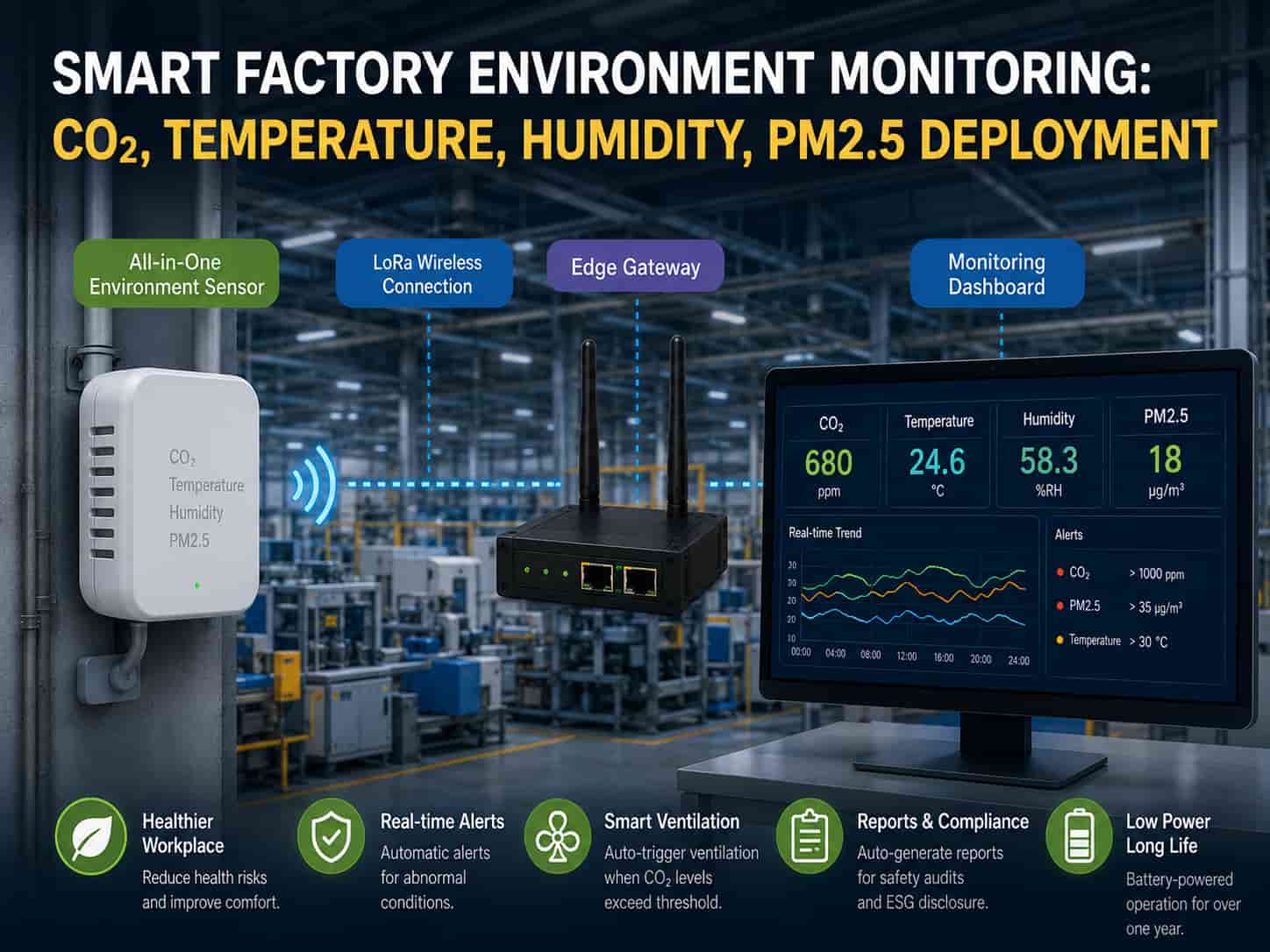
Modern LoRa-based environmental sensors cover 30 to 50 meters per node and run for over a year on a single battery charge. That means a mid-size facility can achieve comprehensive coverage — CO₂, temperature, humidity, and PM2.5 in a single device — without construction, conduit runs, or meaningful disruption to operations.
When a CO₂ threshold is exceeded, the management platform triggers ventilation automatically. When PM2.5 spikes, the alert reaches supervisors immediately. Daily and weekly environmental reports generate without anyone building a spreadsheet.
ESG disclosure requirements, occupational safety audits, and regulatory submissions increasingly demand time-stamped, sensor-sourced environmental records — exactly what a wireless monitoring network produces by default.
Environmental monitoring isn’t a compliance box to check. It’s the kind of operational visibility that makes a facility genuinely safer, more accountable, and more competitive.
FAQ
Q1
At what CO₂ level should a factory start increasing ventilation?
Answer
The standard threshold is 1,000 ppm. Above that level, CO₂ has measurable effects on cognitive performance — increased fatigue, reduced concentration, higher error rates. In enclosed production areas with heavy machinery and high occupancy, reaching that threshold during peak hours is more common than most facilities realize. A smart monitoring system can trigger ventilation automatically before the threshold is crossed, without any manual intervention.
Q2
How complicated is it to install factory environmental monitoring sensors?
Answer
With wireless LoRa sensors, it’s about as straightforward as it gets. There’s no conduit to run, no structural modifications, and no construction work. Sensors mount in position and pair to the network during commissioning — a mid-size facility can typically be fully deployed in a single day. Battery-powered nodes can go anywhere: storage areas, facility perimeters, and areas where running cable isn’t feasible.
Q3
Can factory air quality data be used in ESG disclosures?
Answer
Yes, and it’s increasingly expected. Environmental data like CO₂, PM2.5, temperature, and humidity falls under the environmental and occupational health dimensions of ESG reporting. Continuous, timestamped sensor data carries far more credibility with auditors than manually compiled figures. It’s also more defensible in third-party certification processes where data lineage and collection methodology are scrutinized.

Netio Technologies
Your Best Design Partner !