
From Sensors to Gateways — A Hardware Guide to the IIoT Physical Layer
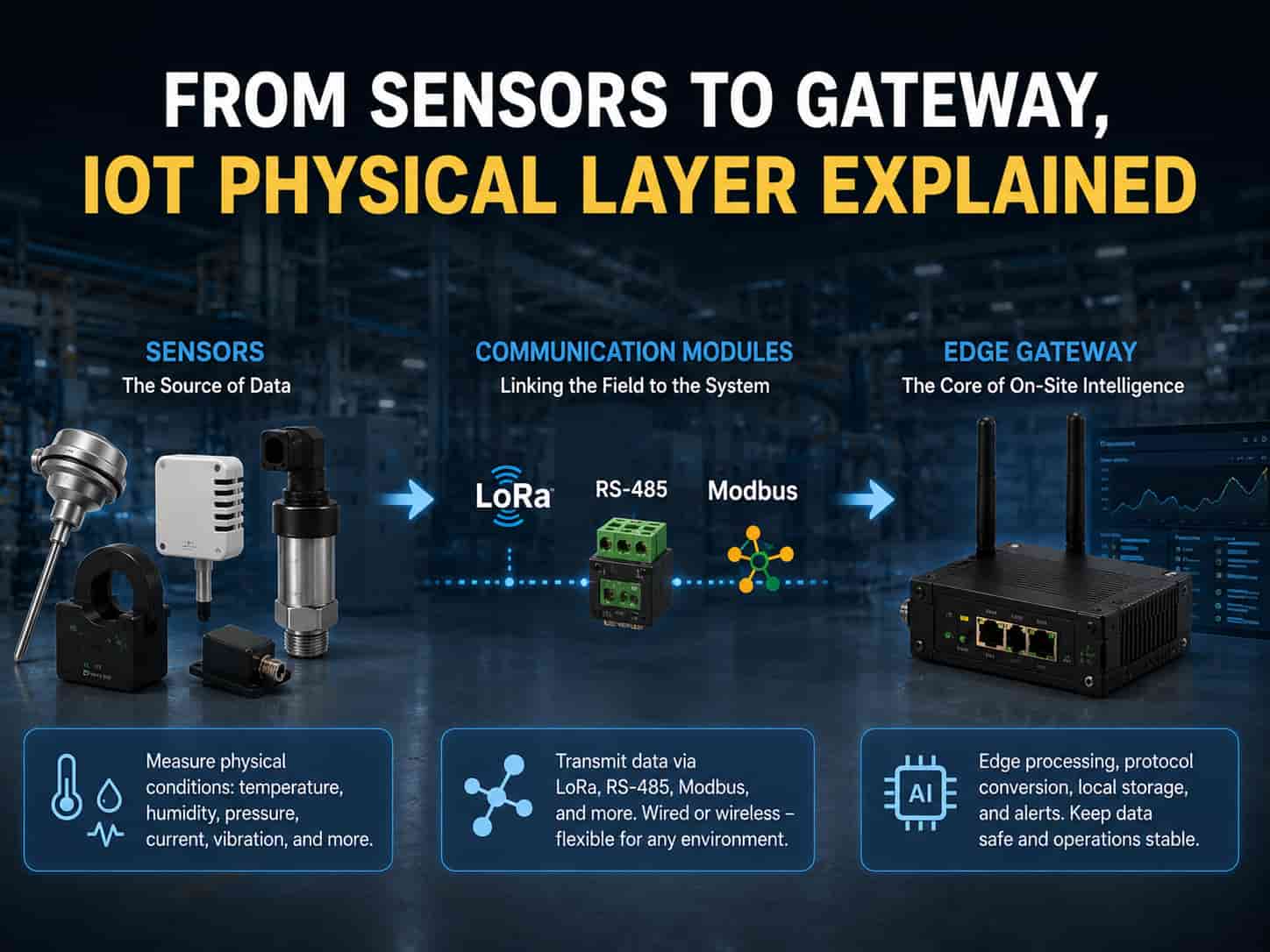
Every industrial IoT system, regardless of how sophisticated its analytics become, depends on one thing holding up at the foundation: hardware that works reliably in the field. The physical layer is where data is born. If the quality isn’t right here, no amount of AI or cloud infrastructure can fix it downstream.
Sensors: Where the Data Starts
Industrial sensors convert physical conditions — temperature, pressure, current, vibration, humidity — into digital signals the system can work with. The distinction between industrial-grade and consumer-grade equipment matters enormously in this context. Industrial sensors are engineered for electromagnetic interference (EMI) resistance, rated for IP65 or higher protection against dust and moisture, and validated for measurement stability over years of continuous operation.
When specifying sensors, sampling rate is a detail that’s easy to overlook and expensive to get wrong. A temperature sensor logging every five minutes is perfectly adequate for environmental monitoring. For detecting early-stage bearing faults through vibration signatures, you need orders of magnitude more resolution.
Communication Modules: The Bridge Between Field and System
The data collected at the sensor level has to get somewhere useful. Communication modules — LoRa, RS-485, Modbus, or Wi-Fi depending on the application — handle that handoff to the edge gateway. In industrial environments, wired options like RS-485 and Modbus RTU remain widely deployed precisely because they’re predictable under harsh electrical conditions. Wireless is expanding rapidly where cable runs aren’t practical. In large facilities, hybrid deployments combining both are increasingly the norm.
Edge Gateways: Intelligence at the Source
A gateway does far more than move data from point A to point B. Modern industrial edge gateways perform local filtering to drop noise before it reaches the network, handle protocol translation (Modbus to MQTT is a common example), buffer data locally during connectivity interruptions, and can trigger immediate responses to anomalies without waiting for a cloud round-trip.
What to look for: multi-protocol support, local compute capacity, and the ability to operate autonomously when the network goes down. These three capabilities determine whether your physical layer is a liability or an asset.
The physical layer is the foundation. Everything built on top of it — the analytics, the dashboards, the AI — is only as good as the data coming in at the bottom.
FAQ
Q1
What makes an industrial-grade sensor different from a standard one?
Answer
Industrial sensors are designed to keep working in conditions that would kill a consumer-grade device: IP65 or higher dust and moisture protection, resistance to electromagnetic interference (EMI), and stable measurement accuracy across temperature extremes, vibration, and chemical exposure. The difference in long-term reliability and measurement consistency between industrial and consumer sensors is substantial — and in a production environment, that difference shows up directly as downtime and bad data.
Q2
What does an industrial IoT edge gateway actually do?
Answer
A lot more than route data. A modern industrial edge gateway handles local data filtering and preprocessing, protocol translation (converting legacy Modbus signals to MQTT, for example), local data buffering during network outages, and time-sensitive anomaly detection that doesn’t require a cloud round-trip. If the internet connection drops, the gateway keeps monitoring and logging — nothing gets lost.
Q3
How do you determine the right sampling rate for IoT sensors?
Answer
Match the sampling rate to the speed of the phenomenon you’re monitoring. Slow-changing parameters like temperature and humidity are well-served by reads every 5 to 15 minutes. Fast-changing parameters — equipment vibration signatures, pressure curves during actuation — may need multiple samples per second. Setting sampling rates too high wastes battery and generates more data than you need; too low and you miss the events that matter.

Netio Technologies
Your Best Design Partner !