
LoRa, Wi-Fi, or 5G — Picking the Right Wireless Technology for Your Industrial Deployment
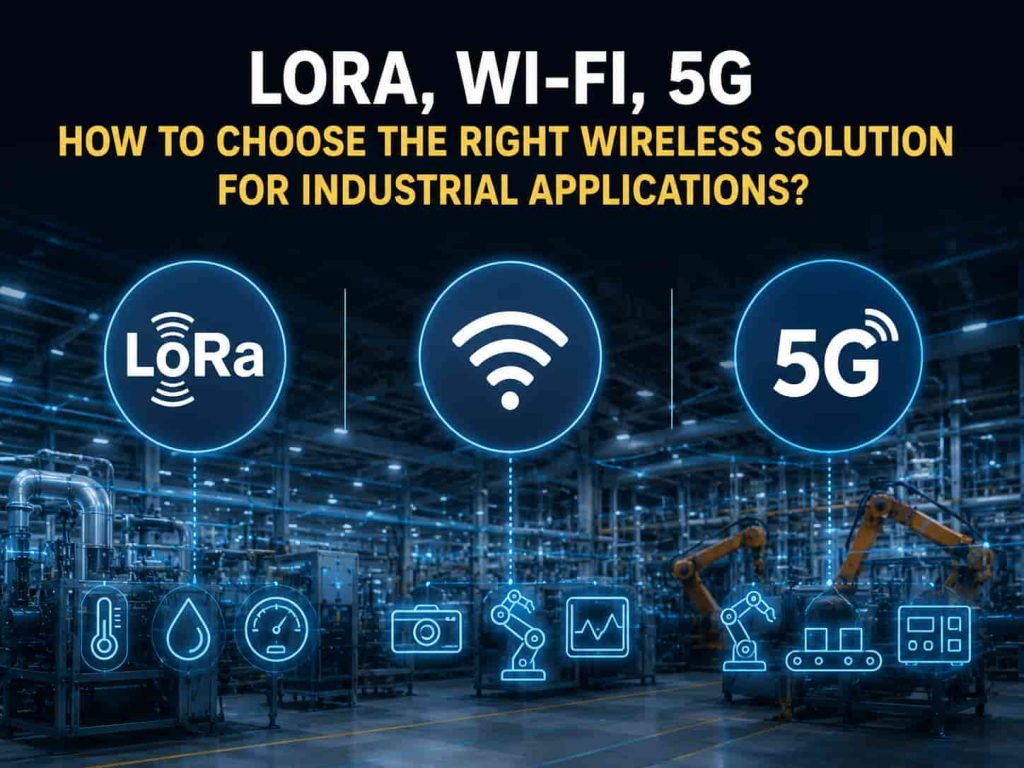
One of the most consequential decisions in any IIoT project is one that often gets underestimated: which wireless protocol actually fits the job? Choose wrong, and you’re looking at coverage gaps, battery drain, or infrastructure costs you didn’t budget for. Choose right, and the system practically runs itself.
The honest answer is that no single technology wins across the board. LoRa, Wi-Fi, and 5G each occupy a distinct niche — and the key is matching the protocol to the problem.
LoRa: Long Range, Low Power, Low Drama
LoRa was built for exactly the kind of environments that give other protocols trouble. A single gateway can cover several kilometers, and sensor nodes running on batteries routinely last years without a swap. That combination — wide coverage, minimal power draw — makes LoRa the default choice for perimeter monitoring, outdoor equipment tracking, legacy facilities where running new cable isn’t realistic, and any application where sensors are spread out and change infrequently. The trade-off is throughput. LoRa isn’t built for high-speed data. But for the vast majority of industrial sensing applications — temperature, humidity, current, pressure — low-frequency readings are exactly what you need.
Wi-Fi: High Speed, Short Range
When your application demands high data rates—vibration spectrum analysis, machine vision, video-assisted quality inspection—Wi-Fi is the right tool. It handles the volume. The limitations are equally real: coverage is shorter, metal-heavy factory environments cause signal attenuation, and battery-powered nodes aren’t realistic given the power requirements. Wi-Fi works best for fixed, wired-power equipment in defined zones.
5G Private Networks: The Long Game
5G delivers ultra-low latency and carrier-grade reliability at scale. For large-scale automation, real-time control loops, or facilities running coordinated robotics across a wide floor, 5G is where industrial wireless is heading. The barrier right now is cost — private 5G infrastructure is a serious capital investment. It makes sense for organizations with a committed, multi-year digital transformation roadmap.
How to Choose
Frame the decision around three axes: sensing frequency, power constraints, and deployment scale. Need wide coverage with minimal power? LoRa. Need high-speed real-time data from fixed equipment? Wi-Fi or 5G. Running a mixed environment? An industrial gateway that handles multiple protocols in parallel is almost always the cleanest solution.
FAQ
Q1
Should my factory’s IoT sensors use LoRa or Wi-Fi?
Answer
It depends on what the sensors need to do. LoRa is the right call for applications requiring wide coverage, long battery life, and low-frequency data — environmental monitoring, equipment utilization tracking, anything deployed in hard-to-wire areas. Wi-Fi is better suited for high-throughput applications like vibration spectrum analysis where you need real-time, high-frequency data. Large facilities often run both in parallel to cover different use cases.
Q2
How long does the battery last on a LoRa sensor?
Answer
Under typical industrial monitoring conditions — uploading readings every 5 to 15 minutes — LoRa sensor batteries generally last 3 to 5 years. Some lower-power designs push past 5 years. That runtime is precisely why LoRa is the preferred solution for legacy facilities, outdoor deployments, and anywhere running new cable isn’t practical.
Q3
Is a 5G private network realistic for a mid-size factory?
Answer
For most mid-size operations, not yet. Private 5G infrastructure requires dedicated base station equipment and spectrum licensing, which puts the upfront cost significantly above LoRa or Wi-Fi deployments. It’s a strong investment for large enterprises with serious automation ambitions and a long-term digital transformation budget. Mid-size facilities typically get better ROI starting with a hybrid LoRa/Wi-Fi architecture.

Netio Technologies
Your Best Design Partner !