
Raw Sensor Data Isn't Valuable. What You Do With It Is.
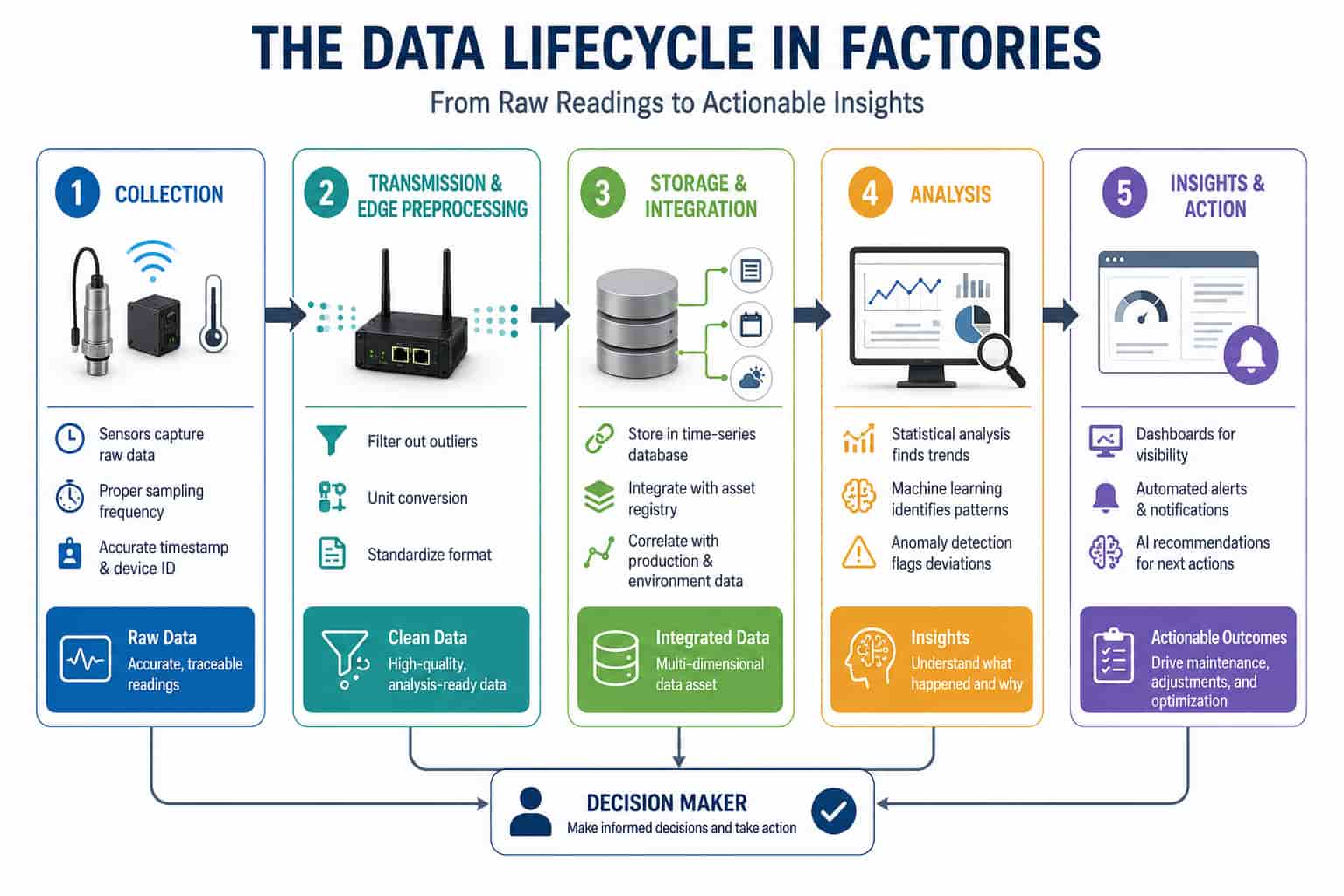
A temperature reading is just a number. A pressure value, a current draw, a vibration amplitude — on their own, these are facts without context. The data that flows out of an industrial sensor network has no inherent business value until it gets processed, interpreted, and acted on.
Stage 1: Collection
Data generation starts at the sensor. The critical questions at this stage: Is the sampling rate high enough to capture the phenomenon you’re monitoring? Does every reading carry an accurate timestamp and a device identifier? Without those two attributes, traceability collapses and everything downstream becomes harder to trust.
Stage 2: Transmission and Edge Preprocessing
Before data reaches the cloud, the edge gateway filters out noise, converts units, and normalizes formats. This step is where data quality gets locked in. Garbage in, garbage out (GIGO) is as true in industrial IoT as anywhere — and the edge layer is where you intercept it before it contaminates your analysis pipeline.
Stage 3: Storage and Integration
Cleaned data lands in a time-series database and gets joined with equipment records, production schedules, and environmental context. This is when isolated readings become a multi-dimensional dataset — the raw material for real analysis.
Stage 4: Analysis
Statistical analysis surfaces trends. Machine learning identifies patterns that don’t fit the norm. Anomaly detection algorithms flag deviations before they become failures. This stage transforms “what happened” into “why it happened” — and starts generating hypotheses about what’s likely to happen next.
Stage 5: Insight and Action
Data reaches decision-makers through dashboards, automated alerts, and AI-generated recommendations. Maintenance gets scheduled. Energy use gets adjusted. Quality parameters get tightened. The loop closes.
Most IIoT initiatives that underperform aren’t failing because of inadequate AI. They’re failing because the data entering the system was never clean enough to analyze in the first place.
FAQ
Q1
What steps does factory IoT data go through, from sensor to decision?
Answer
The full pipeline has five stages: collection (sensors capture readings with timestamps and device IDs), edge preprocessing (local filtering, unit conversion, format normalization), storage and integration (time-series database, joined with equipment and production records), analysis (statistical modeling, machine learning, anomaly detection), and insight delivery (dashboards, automated alerts, AI recommendations). Each stage builds on the last — and a weakness at any point degrades the value of everything that follows.
Q2
Why does IoT data need preprocessing at the edge before it reaches the cloud?
Answer
Raw sensor data contains noise, outliers, and format inconsistencies. Sending all of it directly to the cloud wastes bandwidth and storage, but more importantly, it degrades AI model performance. The principle applies cleanly: garbage in, garbage out (GIGO). Edge preprocessing filters and standardizes data at the source, so the cloud receives clean, consistent inputs. That single step has an outsized impact on the accuracy of everything built on top of it.
Q3
What is a time-series database, and why is it used for IoT data?
Answer
A time-series database is purpose-built for data organized by time — continuous streams of timestamped readings, which is exactly what IoT sensors produce. Compared to general-purpose relational databases, time-series databases handle IoT-scale write volumes far more efficiently, compress sequential data significantly better, and answer time-range queries orders of magnitude faster. For industrial IoT deployments generating thousands of readings per second, the performance difference is material.

Netio Technologies
Your Best Design Partner !