
Edge Computing vs. Cloud Computing — Where Should Your Industrial Data Actually Be Processed?
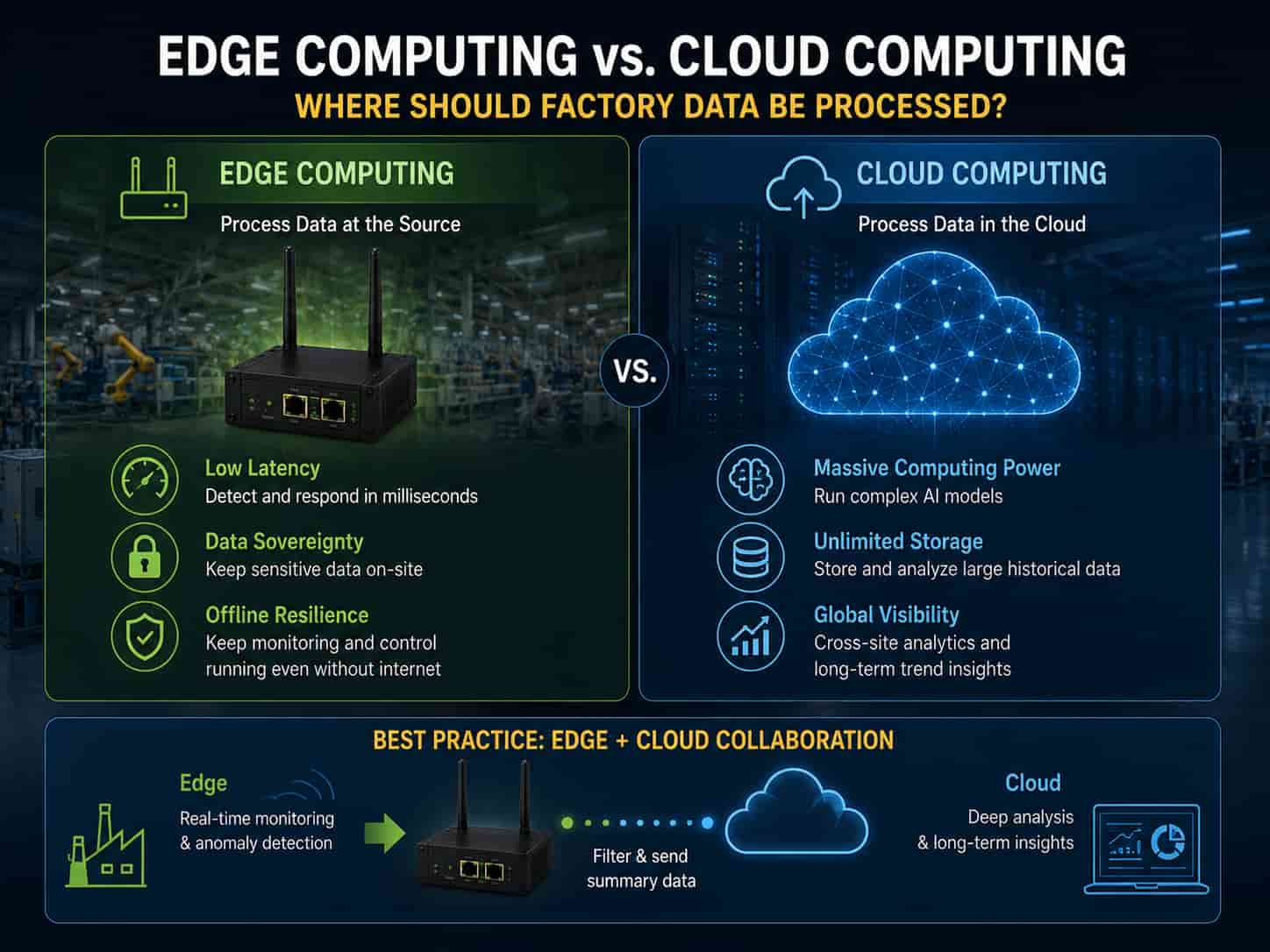
The question comes up in every serious IIoT architecture conversation: should we process data at the edge or in the cloud? The framing is a bit of a false choice — but understanding why it’s false is actually the key to designing a system that works.
The Case for Cloud
Cloud infrastructure offers practically unlimited compute and storage. For applications that require training machine learning models on years of historical data, integrating insights across multiple plant locations, or generating trend reports that span long time horizons, the cloud is the right environment. The economics make sense for workloads that aren’t time-sensitive and don’t require data to stay on-premises.
What Edge Does That Cloud Can't
Three capabilities that edge processing delivers and cloud-only architectures fundamentally cannot:
Latency. When an anomaly needs to trigger an immediate response, you cannot afford the round-trip to a remote server. Edge systems detect and respond in milliseconds. Cloud systems respond in seconds at best.
Data sovereignty. Sensitive production data often carries competitive value that organizations are rightfully reluctant to route through external networks. Edge processing keeps that data on-site, with only summarized or derived outputs leaving the facility.
Resilience. Networks go down. An edge-capable system continues monitoring and controlling during connectivity outages. A purely cloud-dependent system goes dark.
The Architecture That Actually Works
Modern IIoT deployments don’t choose one or the other — they use both. Edge handles real-time monitoring, immediate anomaly response, and local buffering. Filtered, aggregated data pushes to the cloud for long-term analysis, cross-site benchmarking, and AI model training. Each layer does what it’s suited for, and the system as a whole outperforms what either could deliver alone.
The decision isn’t edge versus cloud. It’s deciding which decisions need to be made immediately and which can wait — and building the architecture accordingly.
FAQ
Q1
What’s the difference between edge computing and cloud computing in an IIoT context?
Answer
Edge computing places processing power close to where data is generated — on local gateways at the facility. Cloud computing handles processing on remote servers. The practical difference is latency, data sovereignty, and resilience. Edge processes data in milliseconds and keeps sensitive production information on-site; it also keeps running when the internet goes down. Cloud offers massive storage and compute for deep historical analysis and cross-site integration. The two work best together rather than as alternatives.
Q2
Does all factory IoT data have to go to the cloud?
Answer
No, and for many manufacturers, it shouldn’t. Sensitive production data has competitive value and in some cases regulatory constraints around where it can be stored. A common architecture processes and analyzes data locally at the edge, sending only filtered summaries, alerts, and derived insights to the cloud. Raw operational data stays on-site. This gives you the analytical depth of cloud infrastructure without the exposure.
Q3
Can edge computing keep working during an internet outage?
Answer
Yes, that’s one of its core design requirements. Edge gateways with local storage and onboard processing continue monitoring, logging, and triggering alerts during connectivity outages. When the connection restores, buffered data syncs to the cloud automatically. Nothing falls through the cracks. For production environments where continuous visibility is non-negotiable, this resilience is a fundamental capability.

Netio Technologies
Your Best Design Partner !