Your Equipment Won't Warn You Before It Fails. But AI Can.
Predictive Maintenance Has Moved Beyond Theory: AI-Driven Pressure Analysis Is Catching Failures a Week Before They Happen
A cylinder doesn’t schedule its breakdowns. One moment the line is running fine; the next, everything stops. In a modern manufacturing environment, unplanned downtime doesn’t wait around — costs start stacking at roughly $10,000 per minute. 70% of unplanned downtime traces back to equipment wear. Yet nearly half of all traditional maintenance programs still fail to deliver on their promises. The issue isn’t that facilities are neglecting maintenance. It’s that they’re doing it on the wrong schedule, triggered by the wrong indicators.
Every Cylinder Has a Signature. AI Learns to Read It.
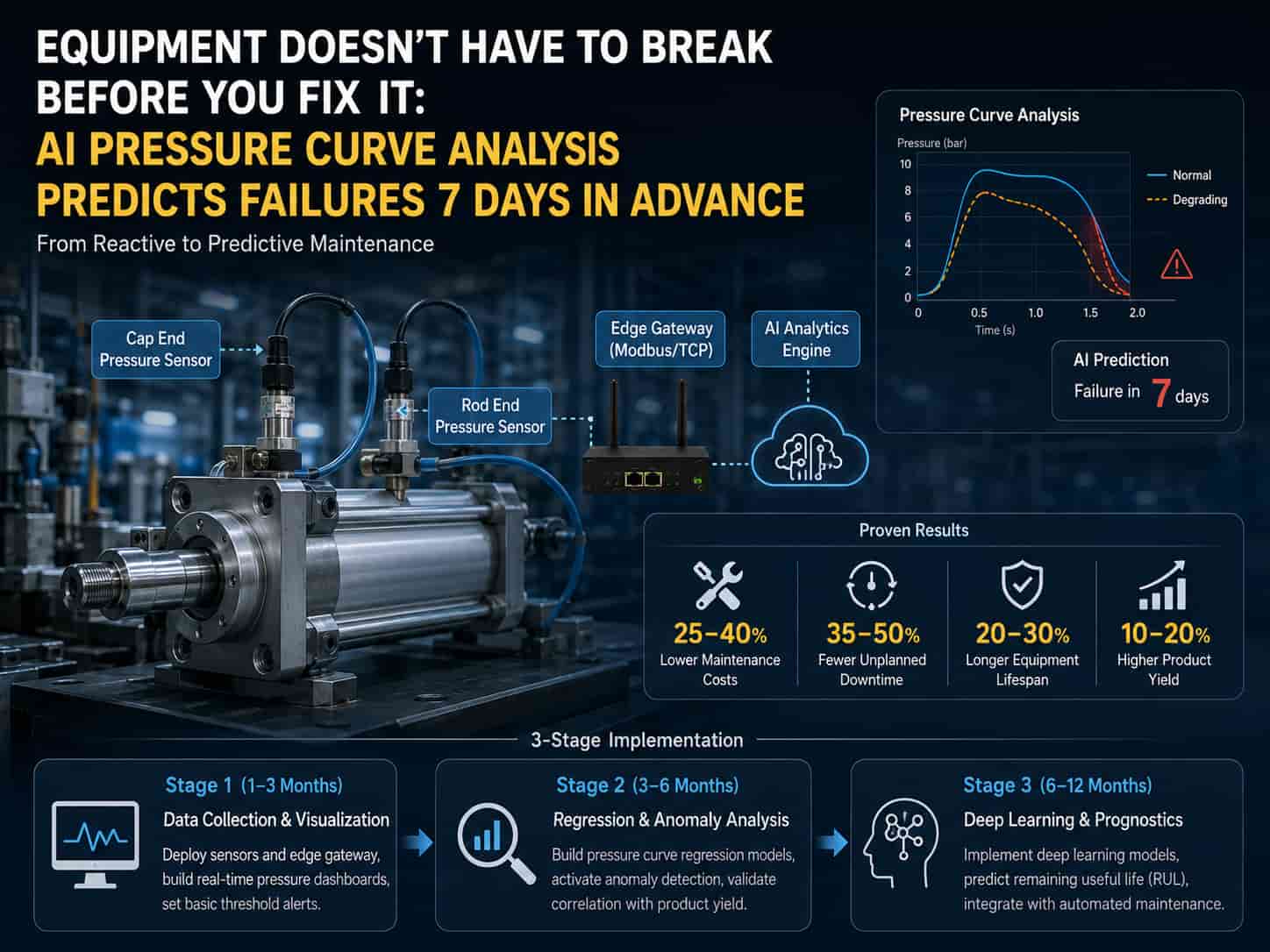
Each time a pneumatic cylinder actuates, the pressure in its intake and exhaust chambers follows a predictable pattern — captured across four key dimensions: peak pressure, rise time, pressure hold, and fluctuation pattern.
On a healthy cylinder, these curves stay remarkably consistent cycle after cycle. The moment the curve starts shifting — even subtly — something is changing inside the machine. By continuously learning the baseline signature for each individual cylinder, the system flags meaningful deviations early: typically identifying failure conditions up to 7 days before a breakdown occurs.
The Business Case: Maintenance Savings Are Just the Start
Maintenance cost reduction: 25–40%. Unplanned downtime reduction: 35–50%. Equipment lifespan extension: 20–30%. Product yield improvement: 10–20%. That last metric tends to surprise people. Cylinder pressure anomalies don’t just cause machine failures — they quietly degrade product quality long before anything visibly breaks. AI monitoring catches the pressure deviation before the first bad part comes off the line.
A Rollout Designed to Work Around Your Operation
Phase 1 (Months 1–3): Install sensors and edge gateways, stand up real-time pressure dashboards, set initial threshold-based alerts.
Phase 2 (Months 3–6): Develop regression models around normal pressure behavior, bring anomaly detection online.
Phase 3 (Months 6–12): Deploy deep learning models for Remaining Useful Life (RUL) prediction, feed insights directly into maintenance scheduling workflows.
AI analysis belongs on the production floor — not buried in a cloud dashboard that nobody checks until something’s already broken.
FAQ
Q1
What’s the difference between predictive maintenance and scheduled maintenance?
Answer
Scheduled maintenance runs on a fixed calendar regardless of what the equipment actually looks like — which means you’re either servicing machines that don’t need it yet, or missing problems that develop between intervals. Predictive maintenance uses continuous sensor monitoring and AI analysis to assess actual equipment condition, triggering recommendations based on real degradation signals rather than the clock. The result is less unnecessary work and fewer surprise failures.
Q2
How does AI detect an equipment failure 7 days in advance?
Answer
AI systems trained on normal equipment behavior detect subtle but consistent deviations in sensor patterns — the kind of shift that’s statistically significant but not yet visible as a performance problem. For pneumatic cylinders, this means tracking changes in pressure rise time, peak hold, and decay rate cycle over cycle. When the pattern drifts from the established baseline, the system flags it. That drift typically becomes detectable 5 to 10 days before an actual failure.
Q3
Can monitoring cylinder pressure curves actually improve product yield?
Answer
It does, consistently. The connection is direct: cylinder pressure anomalies affect clamping force and actuation timing, which means defects start accumulating before any machine alarm fires. AI pressure monitoring catches the deviation before the first bad part comes off the line. Real-world deployments show yield improvements in the 10 to 20% range.

Netio Technologies
Your Best Design Partner !