
The First Thing an AI Agent Does on a Factory Floor — And Why It Matters
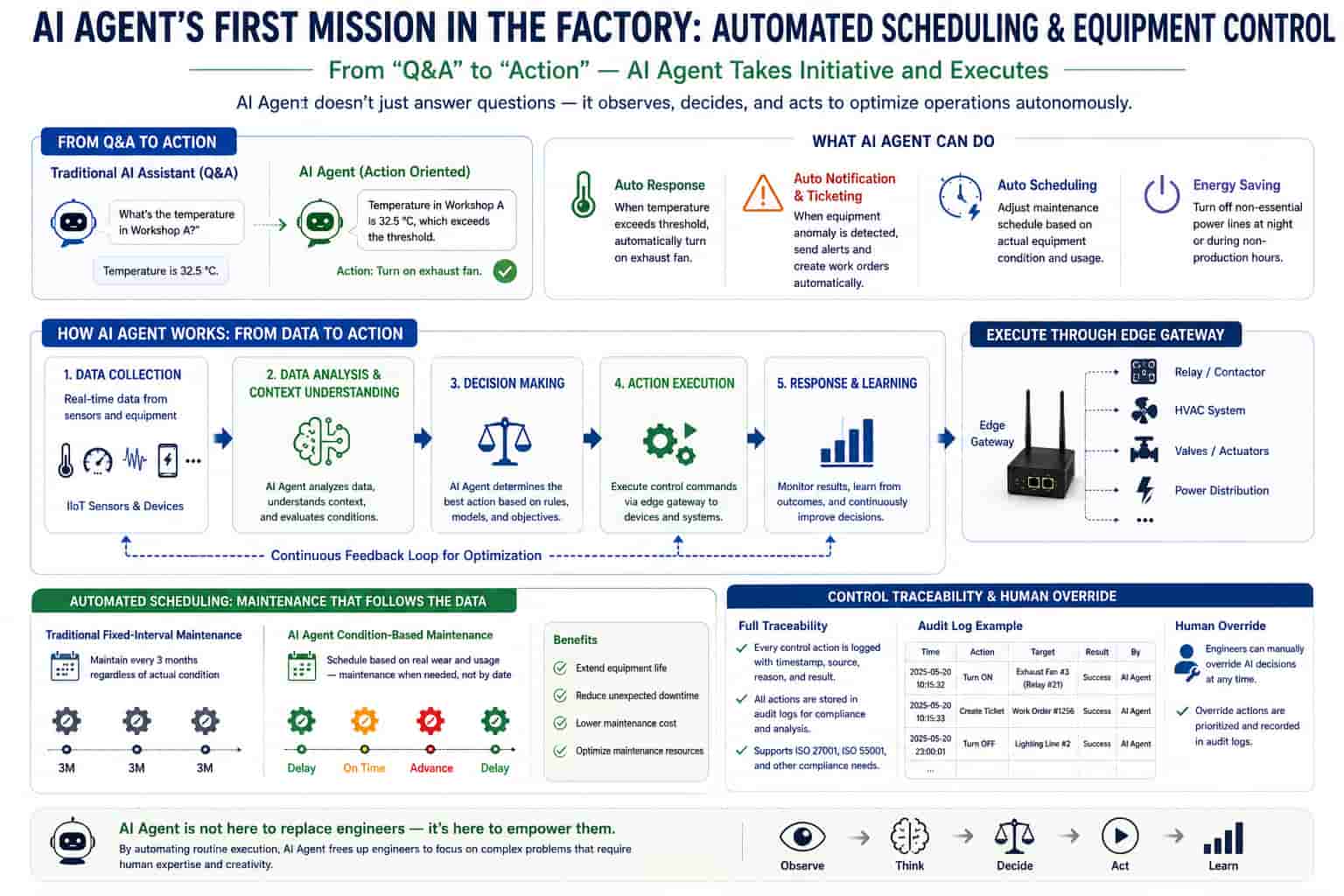
AI agents in industrial settings are moving past the proof-of-concept stage. The first real jobs they’re taking on aren’t sophisticated or glamorous — and that’s exactly the point.
The initial foothold is autonomous action on routine, rule-based decisions that humans currently handle through habit, not judgment: triggering ventilation when CO₂ crosses a threshold, logging a work order when a sensor reading falls outside its normal range, powering down non-essential circuits at the end of the shift. These aren’t decisions that require human wisdom. They require consistent execution — which is precisely what AI agents deliver.
From Answering Questions to Taking Action
Traditional AI assistants in operational settings are informational. They tell you the temperature is elevated, that a particular machine flagged an anomaly, that energy consumption spiked overnight. The information is useful. But someone still has to decide what to do with it.
AI agents close that loop. When a condition is met, the response doesn’t wait for a human to read a dashboard and issue a command. The agent evaluates the situation against its defined parameters and acts — adjusting equipment settings, notifying the right people, opening a maintenance ticket, documenting the event in the audit log.
Maintenance Scheduling That Follows the Data
One of the more impactful early applications is maintenance scheduling. Traditional fixed-interval maintenance plans have a fundamental flaw: they ignore actual equipment condition. AI agents integrated with sensor data adjust maintenance windows dynamically — allocating service resources to the equipment that actually needs them, rather than the equipment that’s next on the schedule.
Control Actions That Are Always Traceable
Every command issued by an AI agent — to a relay, a valve, an HVAC system, a production line — is logged. The audit trail is automatic and complete. Human override authority is always preserved. The agent handles the execution; the engineering team retains decision-making authority over what the agent is allowed to do.
The value isn’t replacing engineers. It’s returning their attention to the problems that actually require engineering judgment.
FAQ
Q1
What is an industrial AI agent?
Answer
An industrial AI agent is an AI system that doesn’t just provide information — it takes action. Where a traditional AI assistant tells you which machine flagged an anomaly, an AI agent responds to that anomaly autonomously: opening a maintenance ticket, adjusting equipment settings, sending notifications to the right people, and logging everything. It operates within human-defined rules and permissions, handling the execution layer so engineers can focus on decisions that require judgment.
Q2
Can an AI agent automatically manage maintenance scheduling?
Answer
Yes — and this is one of the highest-value early applications. Rather than scheduling maintenance on a fixed calendar, an AI agent reads actual equipment condition from sensor data and adjusts windows accordingly. Equipment running under heavy load or showing signs of wear gets scheduled earlier. Equipment in good condition with low utilization gets more time. Maintenance resources flow to where they’re actually needed, not just where the calendar says.
Q3
If AI is controlling equipment automatically, can operators still override it?
Answer
Always. The foundational design principle for industrial AI automation is human override first. Operators can stop, reverse, or modify any AI-initiated action through the interface at any time. Every automated action is logged with a complete record of what happened, when, and why — nothing is a black box. The system is designed to assist human judgment, not replace it. The operator is always in charge.

Netio Technologies
Your Best Design Partner !