
Your Data Center's Energy Bill Is Hiding the Details. Here's How to Find Them.
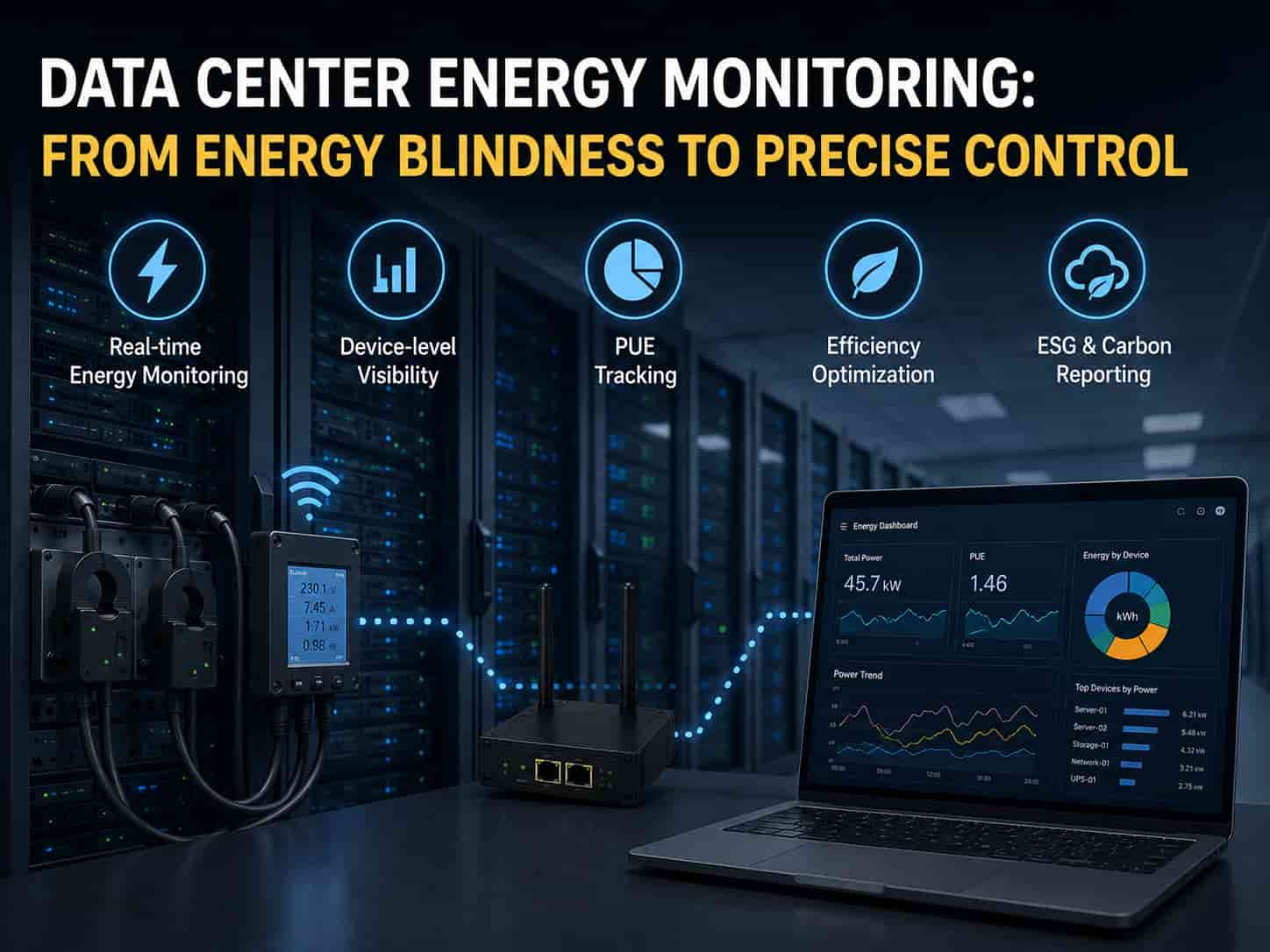
Ask most IT managers what their data center’s PUE (Power Usage Effectiveness) is and they’ll have an answer. Ask them which server is consuming 30% more power than it should, or which PDU circuit has a power factor problem developing quietly in the background — and the conversation stalls.
PUE is a useful headline metric. But it’s a single number representing the ratio of total facility power to IT load. It tells you nothing about what’s happening at the rack, row, or device level. And at the device level is where energy waste actually lives.
The Problem With Aggregate Metering
Without device-level instrumentation, energy management in a data center is largely guesswork. Capacity planning runs on historical averages. Equipment refresh decisions are driven by age, not actual power performance data. Anomalous consumption goes undetected until it shows up as a spike on the monthly bill, or until something fails.
Clip-On Sensors Change the Math
Wireless current sensors clamp directly onto existing conductors—no cutting wires, no interrupting circuits. Smart meters with ±0.5% active power measurement accuracy log consumption by device, by circuit, and by time interval — continuously. All of it pushes to the management platform over LoRa, no new cabling required.
The result is a complete energy profile for every asset in the facility, updated in real time, without a single maintenance window consumed in deployment.
What You Can Actually Do With the Data
Identify your top energy consumers and benchmark them against expected draw. Detect anomalies automatically — when a device’s consumption deviates from its baseline, the system flags it rather than waiting for someone to review a monthly report. Track after-hours standby consumption and find equipment that can be scheduled off. Generate carbon emissions reports with the source traceability that ESG frameworks require.
The first step in data center energy management isn’t replacing equipment. It’s understanding, at the device level, what you’re actually working with. The answers are usually surprising — and often immediately actionable.
FAQ
Q1
What is PUE (Power Usage Effectiveness), and how do you actually improve it?
Answer
PUE measures overall data center energy efficiency: total facility power divided by IT equipment power draw. A PUE of 1.0 means all facility power goes directly to IT equipment; real-world facilities typically run between 1.2 and 2.0. Improving it requires device-level visibility first. You need to know which equipment is consuming what before you can identify inefficiencies in cooling, power distribution, or standby loads — and that’s exactly what device-level monitoring provides.
Q2
Can you monitor each server’s power consumption individually?
Answer
Yes, without any downtime or rewiring. Clip-on current sensors paired with wireless smart meters measure power consumption at the individual device or circuit level with ±0.5% accuracy. The data streams continuously to the management platform. Each server, PDU, and circuit gets its own consumption profile — updated in real time, with full historical records for trend analysis and compliance reporting.
Q3
Does installing data center energy monitoring require taking equipment offline?
Answer
No. The clip-on wireless sensors attach directly to existing conductors — no cutting wires, no interrupting circuits, no maintenance windows required. The entire system deploys while everything stays running. For a data center where downtime is not an option, this is the only practical approach to comprehensive energy instrumentation.

Netio Technologies
Your Best Design Partner !