
The Shift from Reactive to Predictive — How AI Agents Are Changing Industrial Maintenance
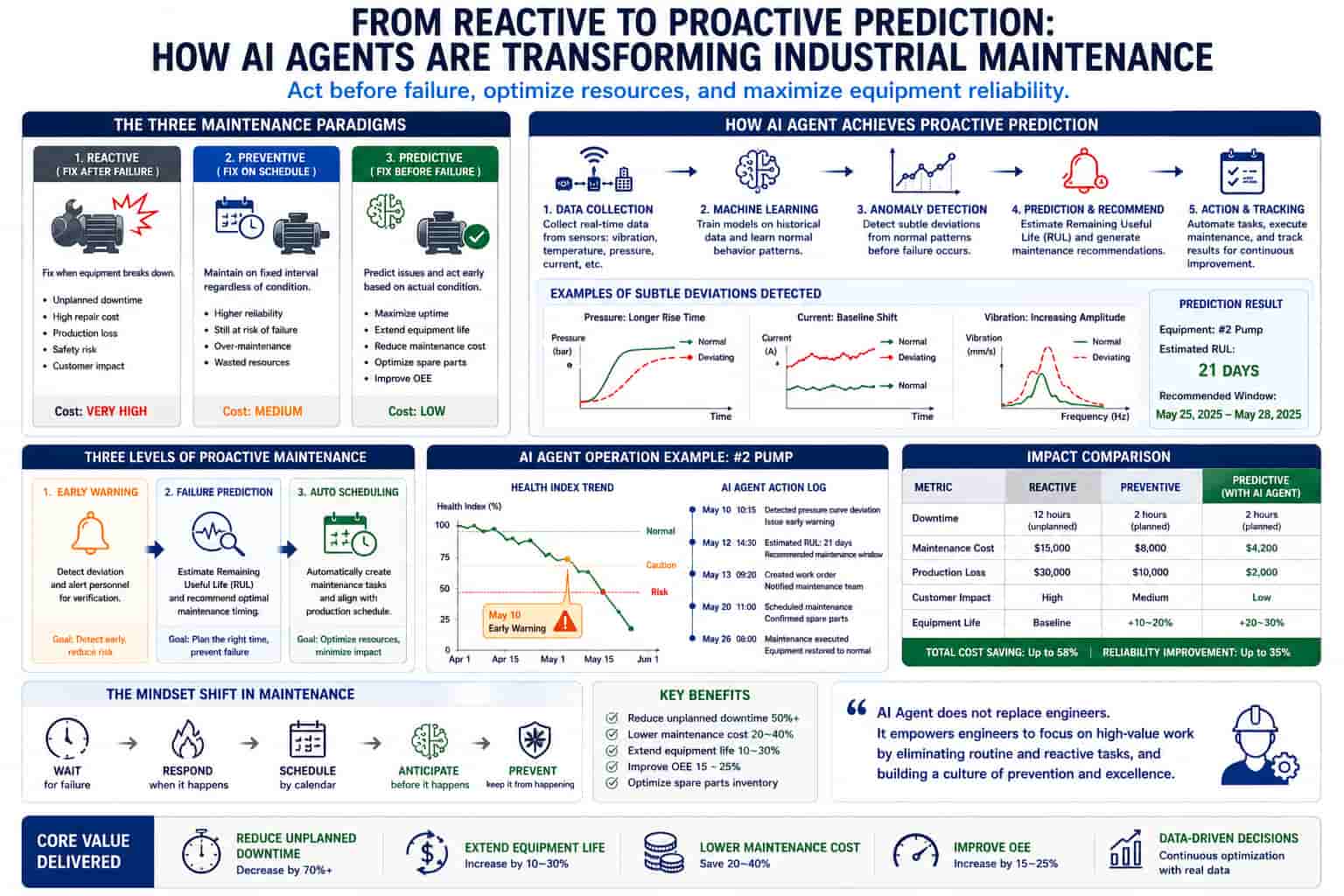
Manufacturing maintenance has operated on two models for most of its history. The first: fix it when it breaks. The second: replace it on a schedule. Both have well-documented failure modes — unplanned downtime on one side, over-maintenance and unnecessary parts replacement on the other. AI agents make a third model viable: intervene before the problem fully develops.
The Hidden Cost of Getting It Wrong
Unplanned downtime typically costs three to five times more than planned maintenance. The math includes not just repair labor and parts, but lost production output, expedited parts procurement at premium prices, and downstream schedule disruption that ripples through customer commitments. Time-based maintenance avoids the worst of that — but generates its own waste. Equipment gets pulled and serviced when it has operational life remaining, because the schedule says so, not because the machine says so.
How Predictive AI Actually Works
AI agents monitoring industrial equipment don’t wait for a threshold to be crossed. They learn the normal behavior of each individual asset — the specific signature of its vibration pattern, the baseline profile of its current draw, the characteristic shape of its pressure curves across operating conditions. When something begins to shift — subtly, before it’s visible to a human reviewer — the system registers it.
The agent’s response is proportionate: generate a maintenance recommendation, surface it to the responsible engineer, and suggest a timing window that fits around the production schedule. Not a fire drill — a managed, planned intervention at the right moment.
Three Levels of Predictive Capability
Level 1 — Anomaly alerting: detect deviation, notify personnel for confirmation.
Level 2 — Failure prediction: estimate Remaining Useful Life (RUL) and recommend the optimal maintenance window.
Level 3 — Automated scheduling: write the maintenance event directly into the production plan, coordinated with line capacity.
Most organizations start at level one and build toward level three as confidence in the system grows and the data history deepens. The underlying shift isn’t really about technology. It’s about moving from a maintenance culture that responds to problems to one that prevents them. AI agents are the most powerful tool the industry has ever had for making that transition.
FAQ
Q1
What’s the practical difference between preventive and predictive maintenance?
Answer
Preventive maintenance operates on a schedule — service every X hours or every Y months, regardless of what the equipment actually needs. Predictive maintenance operates on condition: continuous sensor monitoring feeds AI analysis that assesses real equipment health and recommends maintenance only when the data supports it. Preventive maintenance reduces unplanned failures but often over-services equipment that’s fine. Predictive maintenance reduces both unnecessary work and surprise breakdowns simultaneously.
Q2
How does AI estimate a piece of equipment’s Remaining Useful Life (RUL)?
Answer
AI models trained on historical sensor data learn the degradation patterns that precede specific failure modes — how pressure curves shift, how current draw drifts, how vibration signatures evolve as components wear. Given current sensor readings and the established degradation trajectory, the model projects forward to estimate how much operational life remains before failure becomes likely. RUL accuracy improves over time as the model accumulates more data from the specific asset and its operating context.
Q3
How long does it take to see results from AI predictive maintenance?
Answer
Most deployments follow a predictable progression. Months 1 to 3 focus on instrumentation and visualization — equipment condition becomes transparent for the first time. Months 3 to 6 bring anomaly detection online, and early warnings start appearing before issues escalate. By months 6 to 12, the AI model has enough history to generate reliable RUL estimates and integrate with maintenance scheduling. Maintenance cost reductions typically become measurable in this final phase.

Netio Technologies
Your Best Design Partner !