
Your ESG Carbon Data Has a Source Problem. IoT Sensors Fix It.
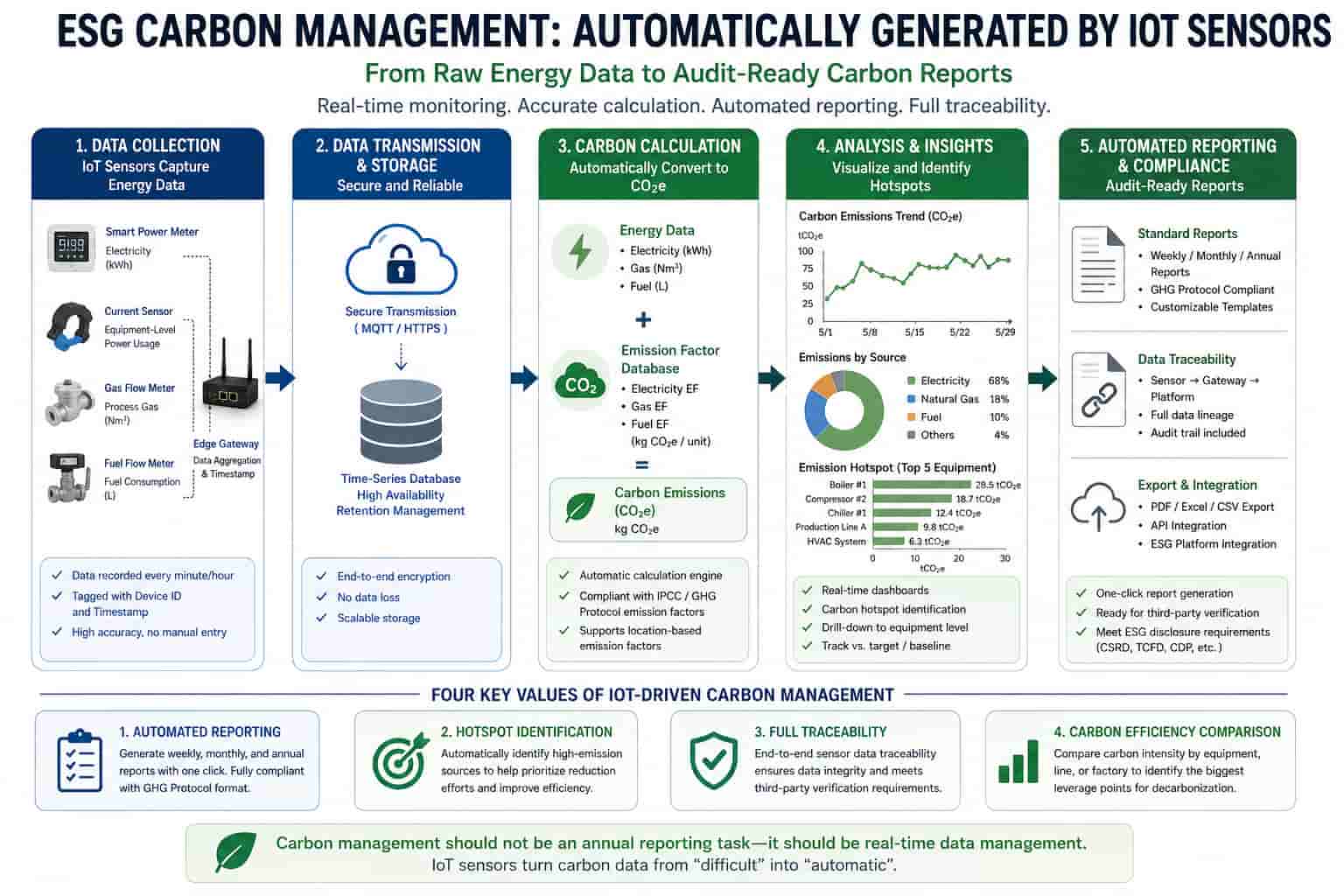
Carbon emissions reporting has moved from optional to expected to mandatory in most major markets. The pressure is coming from regulators, institutional investors, and enterprise customers simultaneously. And many manufacturers face the same uncomfortable reality: they’re expected to report emissions data they don’t actually have — at least not with the accuracy or traceability that modern frameworks require.
Where Industrial Carbon Emissions Come From
Manufacturing’s emissions footprint is largely driven by energy consumption. Electricity use, fuel combustion, and process gas consumption are the primary inputs to any Scope 1 and Scope 2 calculation. The challenge has always been getting those numbers with enough granularity, accuracy, and traceability to be credible — and to identify which operations and which assets are the biggest contributors.
How IoT Changes the Calculation
Deploy smart meters and current sensors across your production equipment, and every device’s energy consumption gets logged automatically — at the hour or minute level, with device IDs and timestamps attached to every reading. Apply your regional emissions factors, and that electricity data converts directly into CO₂ equivalent figures without manual intervention.
The resulting records are continuous, traceable, and auditable. They meet GHG Protocol methodological requirements. They can be broken down by facility, production line, or individual asset. And they don’t require anyone to compile a spreadsheet at the end of the month.
The Practical Benefits Beyond Compliance
Automatic identification of high-emissions equipment — exactly where reduction efforts will have the most impact. Continuous tracking rather than annual snapshots, enabling real operational decisions rather than after-the-fact reporting. Third-party verification becomes straightforward when the data trail leads directly to calibrated sensors with traceable measurement histories.
Carbon management shouldn’t be an annual reporting exercise. With IoT infrastructure in place, it becomes a continuous operational discipline — and the data quality gap that’s made it difficult disappears.
FAQ
Q1
What does factory carbon emissions data need to look like to meet ESG reporting standards?
Answer
Credible ESG carbon data needs to be complete (covering all material emission sources), traceable (timestamped with equipment and measurement source identified), and calculated using a recognized methodology like the GHG Protocol. IoT smart meters that automatically log energy consumption by device, hour, and circuit — then apply official grid emission factors — produce exactly this kind of audit-ready data without any manual assembly.
Q2
Can IoT sensors automatically calculate a factory’s CO₂ emissions?
Answer
Yes, end-to-end. Smart meters record each device’s energy consumption in kWh. The platform applies the appropriate regional grid emission factor and calculates CO₂ equivalent tonnage automatically. The process runs continuously — hourly or daily updates — with no manual entry and no waiting until month-end for a number. Every figure is traceable back to a specific sensor, device, and timestamp.
Q3
What does carbon data need to look like to pass third-party verification?
Answer
Verifiers look for three things: traceable data sources (sensor specifications, calibration records), recognized calculation methodology (GHG Protocol Scope 1 and Scope 2), and no material gaps in the record. IoT-generated data passes these tests far more easily than manual records because every data point carries a device ID, timestamp, and unbroken measurement chain. The audit trail is built in from the start.

Netio Technologies
Your Best Design Partner !