
SPC and AI Anomaly Detection — How to Use Both and Why You Need Both
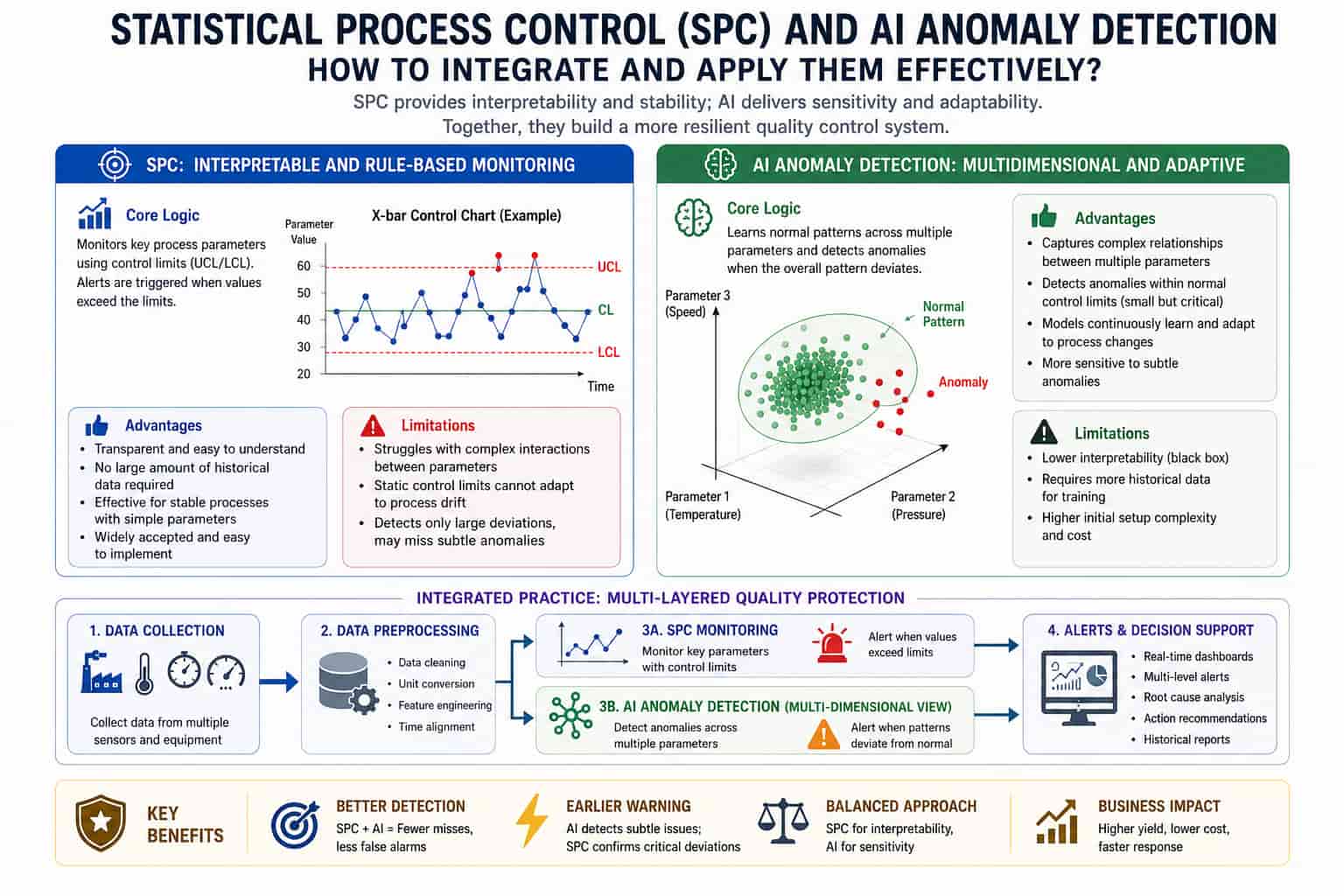
Statistical Process Control has been a fixture of manufacturing quality management for decades. It works. It’s transparent. It’s auditable. And for straightforward, single-variable monitoring against stable specifications, it’s still hard to beat. But SPC was designed for a world of simpler processes. In modern manufacturing environments, where dozens of interdependent variables interact to determine output quality, traditional SPC has limits that show up in ways that are frustrating and expensive.
What SPC Does Well
SPC tracks individual process parameters against statistically derived control limits. When a measurement crosses an upper or lower control limit (UCL/LCL), an alert fires. The logic is transparent — operators understand what triggered the alarm and why. For stable, well-characterized processes with straightforward monitoring needs, SPC remains a highly effective tool.
Where SPC Falls Short
The problem emerges when process quality is determined by the interaction of multiple variables rather than any single one. Temperature, pressure, and motor speed might each sit comfortably within their individual control limits while their combined effect on yield is drifting steadily in the wrong direction. SPC, operating on each variable independently, won’t catch that. Its control limits are also static — they don’t adapt as processes evolve naturally over time.
What AI Anomaly Detection Adds
Machine learning models don’t evaluate variables in isolation. They learn the normal patterns of interaction across the entire parameter space and flag deviations from that learned baseline — even when every individual variable looks fine. They also update continuously, adapting to legitimate process drift rather than treating it as noise.
The Right Architecture: Both, Together
Use SPC for real-time monitoring of critical individual parameters — it’s fast, interpretable, and reliable for what it was designed to do. Deploy AI models to handle cross-parameter anomaly detection, where the complexity exceeds what SPC was built for. The combination creates multiple layers of quality protection without sacrificing the transparency that operators and auditors depend on.
These tools aren’t competing. They’re complementary — and together they cover ground that neither can cover alone.
FAQ
Q1
What’s the difference between Statistical Process Control (SPC) and AI anomaly detection?
Answer
SPC monitors individual process parameters against fixed statistical control limits — when a value crosses the upper or lower bound (UCL/LCL), an alert fires. It’s transparent, auditable, and effective for stable single-variable monitoring. AI anomaly detection learns the interaction patterns across multiple variables simultaneously and flags deviations from that learned baseline — even when every individual variable looks normal. SPC is fast and interpretable; AI catches the complex, multi-dimensional anomalies that SPC was never designed for.
Q2
How much historical data does an AI anomaly detection model need to get started?
Answer
For an initial baseline model, 2 to 4 weeks of normal operating data is typically sufficient. More data improves precision and reduces false positive rates. In the early phase when data is limited, running rule-based alerts like SPC alongside the AI system is a practical transition strategy — SPC provides immediate coverage while the AI model builds its understanding of normal behavior. The two complement each other well during ramp-up.
Q3
How do SPC and AI work together in a production environment?
Answer
The most effective approach uses both in parallel, each doing what it’s best at. SPC handles real-time monitoring of individual critical parameters where interpretability and speed matter most. AI models handle cross-parameter pattern analysis, gradual trend detection, and long-range anomaly identification that falls outside SPC’s scope. Together they create multiple layers of quality protection — SPC for fast, explainable alerts; AI for deep pattern recognition. Neither replaces the other.

Netio Technologies
Your Best Design Partner !