
OT Meets IT — The Engineering Challenge Nobody Warned You About
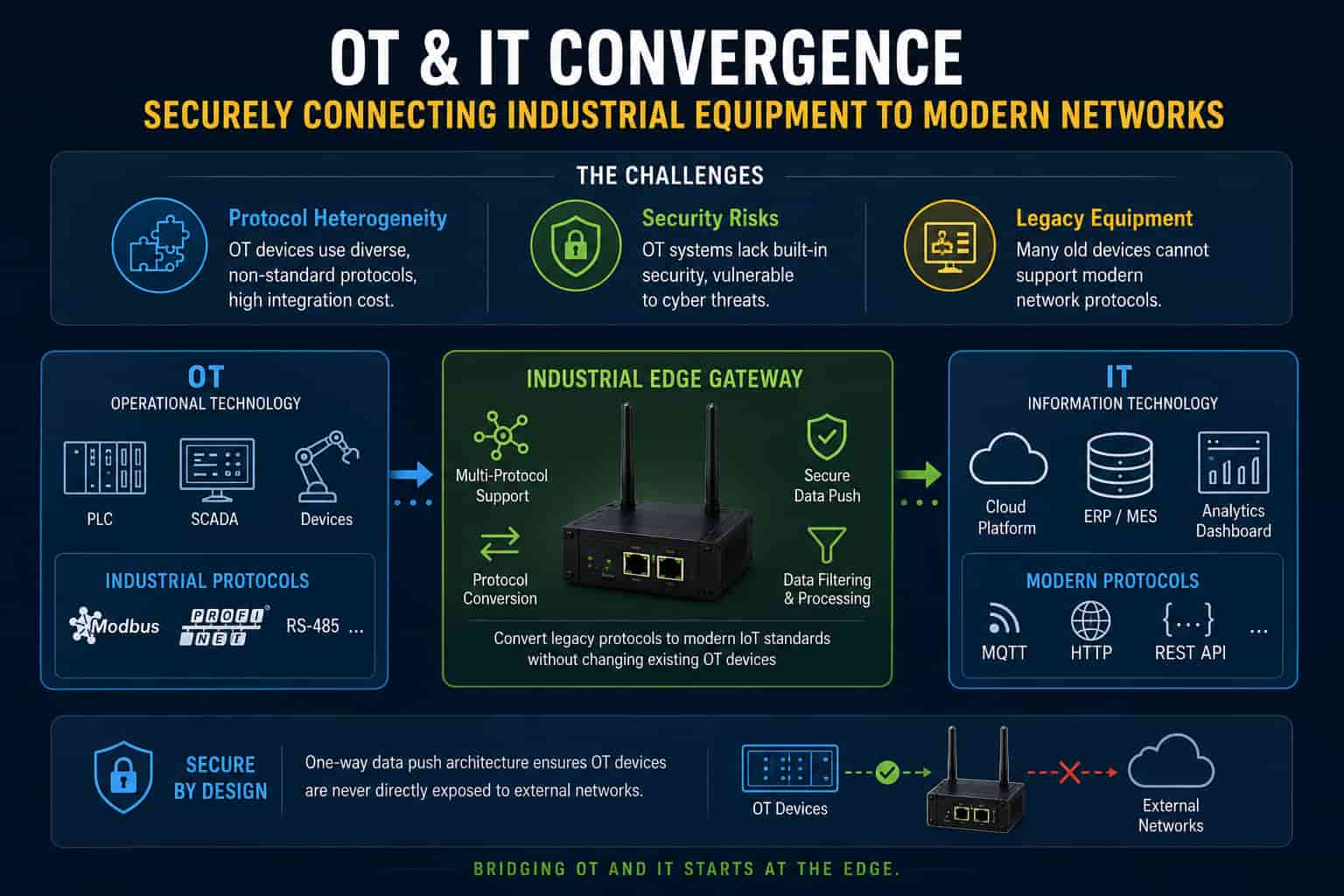
For most of the history of industrial operations, the production floor and the enterprise network lived in separate worlds. Operational technology (OT) — PLCs, SCADA systems, distributed control systems — was optimized for deterministic, real-time control in isolated environments. IT infrastructure was built for data processing and network connectivity. Neither was designed to talk to the other. That separation has become a liability.
Three Challenges That Make This Harder Than It Sounds
Protocol fragmentation: OT environments run on Modbus, PROFINET, EtherNet/IP, DNP3, and dozens of other industrial protocols that predate modern internet standards. Bridging to TCP/IP-based IT infrastructure isn’t plug-and-play.
Security exposure: OT systems were never designed with external network connectivity in mind. Connecting them to IT networks without careful architectural controls opens attack surfaces that traditional IT security tools weren’t built to address.
Legacy equipment: A significant portion of production assets in most facilities are 10, 20, or 30 years old. They don’t have Ethernet ports. They weren’t designed to be networked. But they represent enormous capital investment and aren’t going anywhere soon.
The Edge Gateway as a Convergence Bridge
Industrial edge gateways with multi-protocol support solve this without requiring modifications to existing OT equipment. The gateway sits between the OT environment and the IT network, translating legacy protocols into modern standards (Modbus RTU to MQTT, for example), and enforcing a one-way data flow architecture that keeps OT devices from being directly exposed to external networks.
The result: production data flows into enterprise systems and cloud platforms, OT devices remain isolated from direct network access, and the security posture of the overall environment improves rather than erodes.
OT/IT convergence doesn’t require ripping and replacing production infrastructure. It requires a thoughtful integration layer — and a clear-eyed view of where the risks actually live.
FAQ
Q1
What does OT/IT convergence mean, and why does it matter for manufacturers?
Answer
OT (Operational Technology) is the world of PLCs, SCADA systems, and production equipment. IT (Information Technology) is the world of ERP, databases, and business networks. Convergence means bridging the two so that production floor data flows in real time into business systems — enabling live production visibility, data-driven decision-making, and the kind of integrated operational intelligence that smart manufacturing depends on. It’s a prerequisite for most meaningful digital transformation initiatives.
Q2
Can legacy PLC equipment be connected to a modern IoT system?
Answer
Yes, without replacing the PLC. Industrial edge gateways with multi-protocol support read data from PLCs using Modbus RTU, RS-485, and other legacy protocols, then translate and forward it to modern IoT platforms via MQTT or HTTP. The existing equipment doesn’t need to be touched or upgraded. Legacy production lines can be brought into a digital monitoring architecture while continuing to operate exactly as before.
Q3
Does connecting OT equipment to a network create cybersecurity risks?
Answer
It introduces risks that need to be managed — but the architecture can be designed to minimize them. The standard approach uses an edge gateway as a security boundary between OT and IT networks, with a one-way data push configuration that prevents the IT-side network from directly reaching OT devices. OT and IT networks are segmented physically or logically, with only necessary data channels open. Designed correctly, converged OT/IT architecture is significantly more secure than the informal connections that often exist in legacy environments.

Netio Technologies
Your Best Design Partner !