
How IIoT Systems Actually Work — A Layer-by-Layer Breakdown
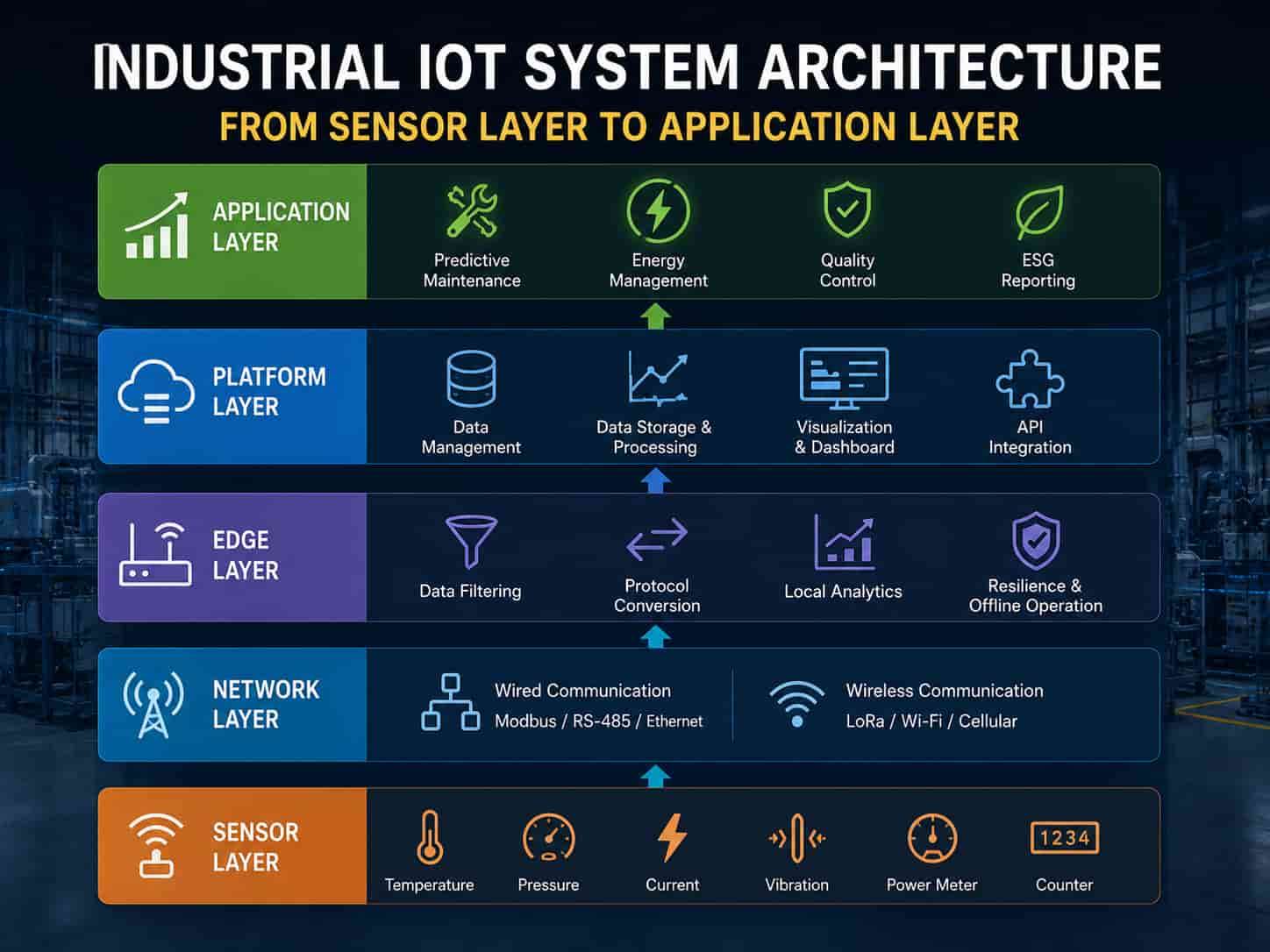
Industrial IoT gets talked about as if it’s a single product you buy and install. It isn’t. It’s a stack — a sequence of interconnected layers that each play a specific role in getting raw physical data from a sensor to a decision-maker’s screen.
The Sensing Layer
This is where the physical world meets the digital one. Sensors, meters, and counters convert real conditions — temperature, pressure, current draw, vibration, flow rate — into signals the system can process. Sensor accuracy, industrial protection ratings, and sampling rates aren’t specifications to skim; they determine what’s knowable from day one.
The Network Layer
Collected data has to move. Whether it travels over Modbus, RS-485, LoRa, or Wi-Fi depends on the physical environment, the data frequency requirements, and the infrastructure already in place. The challenges at this layer are signal reliability in electromagnetically noisy environments, protocol interoperability across different equipment generations, and making sure the communication infrastructure doesn’t become the bottleneck.
The Edge Layer
Before data reaches the cloud, an edge gateway processes it locally. Filtering out noise, converting between protocols, buffering against connectivity interruptions, running time-sensitive detection logic — all of this happens at the edge. The payoff is a system that continues functioning when the network drops and doesn’t flood cloud infrastructure with raw, unprocessed signals.
The Platform Layer
Processed data aggregates in a cloud or on-premises platform that handles storage, visualization, historical querying, and API integration with other enterprise systems. This is where the data becomes accessible to the people and tools that need it.
The Application Layer
This is where business value is actually created. Predictive maintenance systems, energy management dashboards, quality control analytics, ESG reporting tools — all of these live at the application layer. It’s also where AI does its most visible work: not just recording what happened, but anticipating what’s likely to happen next.
Each layer depends on the one below it. Organizations that try to shortcut the stack typically discover the hard way that a weak physical layer makes everything above it unreliable.
FAQ
Q1
What are the layers of an industrial IoT (IIoT) system?
Answer
IIoT systems are organized into five layers. The sensing layer gathers physical data — temperature, pressure, current, vibration. The network layer moves data via wired or wireless protocols. The edge layer preprocesses data locally before it reaches the cloud. The platform layer handles storage, visualization, and system integration. The application layer is where business value gets created: predictive maintenance, energy management, quality control, ESG reporting. Each layer’s reliability affects the entire system above it.
Q2
How is industrial IoT different from consumer IoT?
Answer
The requirements are fundamentally different. Industrial IoT has to hold up under harsh physical conditions — dust, moisture, temperature extremes, electromagnetic interference — and maintain precise measurement accuracy over years of continuous operation. It also needs to speak the legacy protocols factory equipment already uses: Modbus, PROFINET, RS-485. Consumer IoT prioritizes convenience and low cost. In an industrial environment, the failure modes of under-specified equipment are measured in production downtime and bad data.
Q3
Where do you start when planning an industrial IoT deployment?
Answer
Start with the problem, not the technology. Define what you’re trying to achieve — energy reduction, maintenance improvement, quality control, ESG compliance — before choosing sensors or platforms. Once the objective is clear, spec the sensors and communications to match. Then start with a pilot deployment, validate the value, and scale from there. Organizations that start with the technology and work backward to the use case consistently struggle to justify ROI.

Netio Technologies
Your Best Design Partner !