Solutions > Industrial Ethernet > Data-Only vs. Data + Power — Two Deployment Architectures for 10BASE-T1L
Data-Only vs. Data + Power — Two Deployment Architectures for 10BASE-T1L
10BASE-T1L combines
long reach, integrated power, without replacing existing infrastructure
When deploying a 10BASE-T1L system, engineers must first select the appropriate system architecture based on the power requirements of the field devices. 10BASE-T1L supports two primary deployment modes:
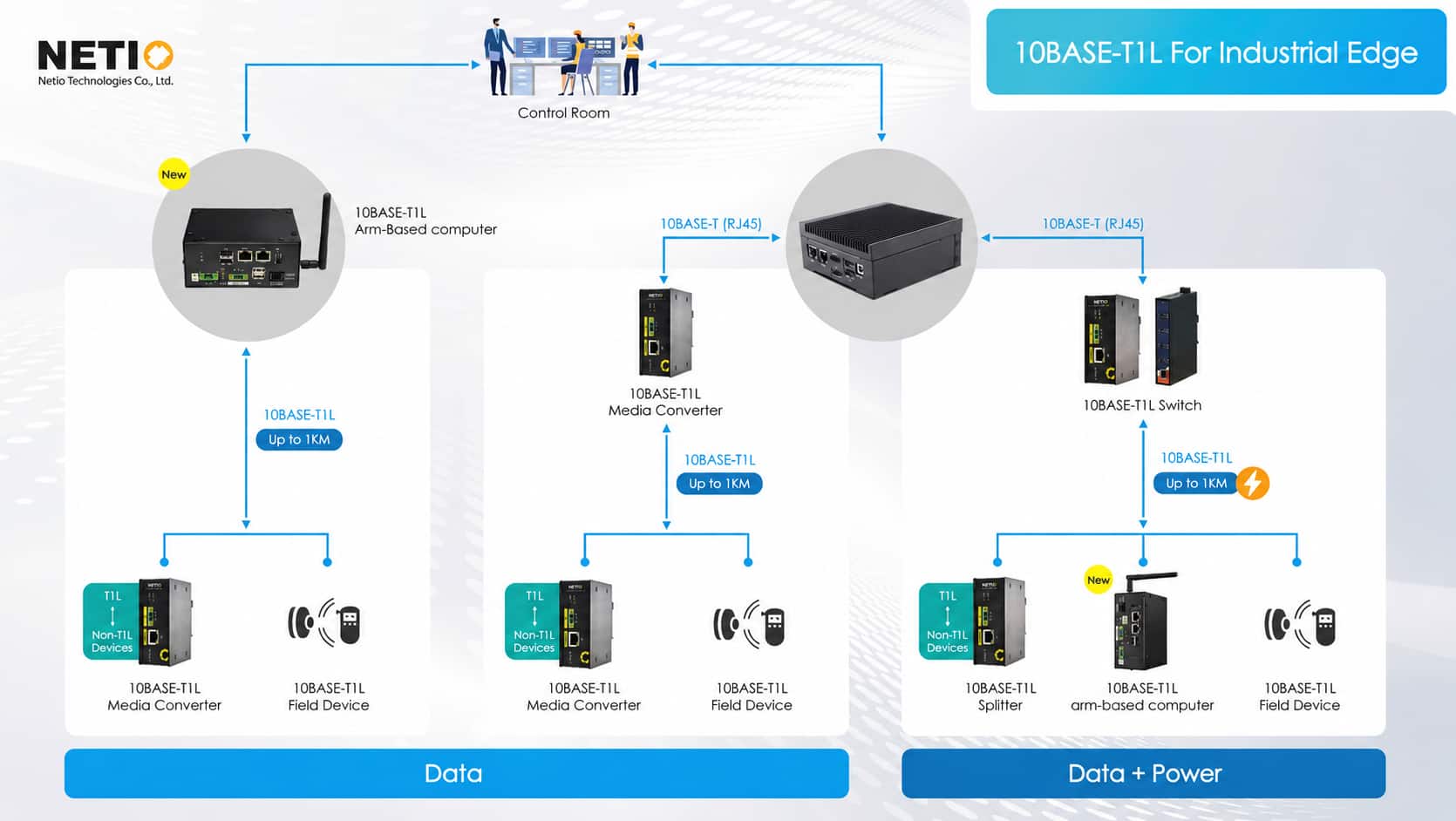
Mode 1: Data-Only Transmission
When field devices such as sensors or actuators already have an independent power supply, 10BASE-T1L is used solely as a communication medium. This mode features the simplest circuit design, where only a Common Mode Choke (CMC) is required between the PHY devices, without any PoDL-related power injection components.
This approach also represents the least intrusive migration path when upgrading from legacy fieldbus systems.
Mode 2: Data + Power (PoDL Mode)
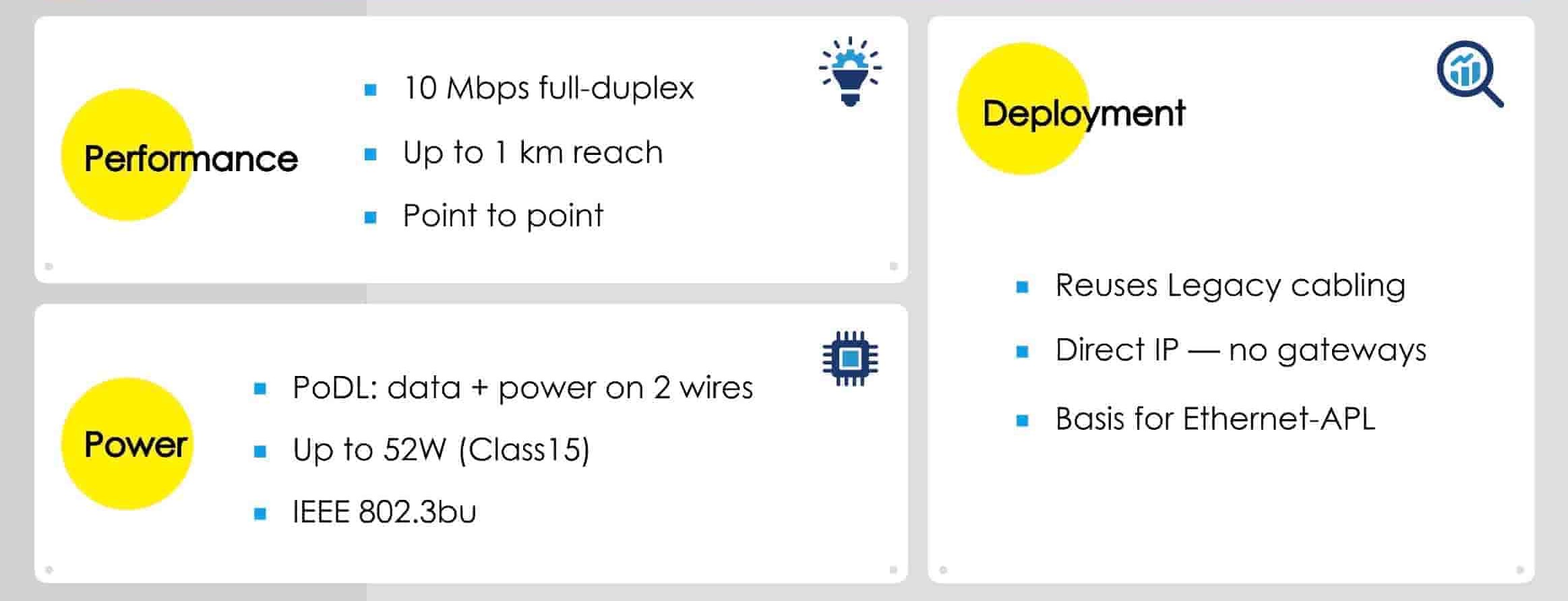
When field devices need to receive operating power through the same communication pair, the PoDL architecture is used. On the PSE (Power Sourcing Equipment) side, DC voltage is superimposed onto the data pair through a Power Injection Choke. On the PD (Powered Device) side, the corresponding circuitry extracts the power and supplies it to the device. This architecture eliminates the need for separate power cabling, offering significant advantages in new installations as well as retrofit scenarios where adding additional power lines is difficult or costly.
It is important to note that these two modes are not mutually exclusive. Within the same system, some nodes may operate in a Data-Only configuration while others use a PoDL architecture, allowing flexible deployment based on the specific requirements of each field device. This provides a high degree of system design flexibility.
When should a data-only architecture be chosen versus a data + power (PoDL) architecture?
Answer
A data-only architecture suits scenarios where field devices already have independent power supplies — such as equipment rooms or large control panels — where SPE cable only needs to provide long-distance, high-speed data connectivity. A data + power (PoDL) architecture is ideal where field devices lack convenient access to separate power lines, such as remote sensors or outdoor monitoring nodes, dramatically simplifying cabling.
Q2
What are the key factors to consider when selecting a deployment architecture?
Answer
Key considerations include: whether end devices already have power (determines if PoDL is needed); device power consumption (determines PoDL Class selection); cable run length and existing infrastructure condition (affects viable PoDL Class range); and whether the location is a hazardous area (determines if the Ethernet-APL intrinsic safety specification is required).
Q3
From a cost perspective, what tangible savings does a PoDL architecture deliver?
Answer
PoDL allows a single twisted-pair cable to simultaneously handle both data transmission and power supply, eliminating the material and installation costs of separate power wiring. In scenarios with many distributed sensor nodes — such as factories or commercial buildings — the savings from eliminated power cable runs are substantial, potentially reducing overall field electrical installation costs.
Netio Technologies
Your Best Design Partner !
We use cookies on our website to give you the most relevant experience by remembering your preferences and repeat visits. By clicking “Accept All”, you consent to the use of ALL the cookies. However, you may visit "Cookie Settings" to provide a controlled consent.
This website uses cookies to improve your experience while you navigate through the website. Out of these, the cookies that are categorized as necessary are stored on your browser as they are essential for the working of basic functionalities of the website. We also use third-party cookies that help us analyze and understand how you use this website. These cookies will be stored in your browser only with your consent. You also have the option to opt-out of these cookies. But opting out of some of these cookies may affect your browsing experience.
More product information
Thank you for reaching out. We will get back to you as soon as possible.